
 Contact
 Hoe winkelen bij ons werkt
Bezorging
Winkelgids
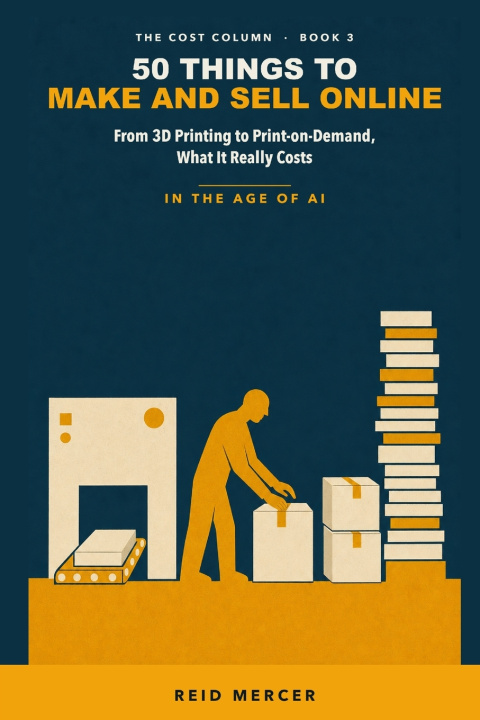
50 Things to Make and Sell Online
From 3D Printing to Print-on-Demand, in the Age of AI - What the Machine Costs, What the Postage Eats, and Who Should Skip It
 Engels
 40 b
40 b
 Nieuw
Nieuw
Tot 30 dagen retourrecht

There is a photograph that sells this whole category: a tidy bench, a printer mid-job, a row of finished objects, and a caption about quitting a job. What it leaves out is the shelf of failed prints behind the camera, the postage receipts, and the arithmetic showing that the twenty-four dollar order produced about six dollars once everything came out of it.
That arithmetic is the reason for this book.
50 Things to Make and Sell Online is the physical lane - where the internet is your storefront rather than your product, and where, unlike the rest of this series, you can lose real money before the first sale. A printer, a heat press, a kiln, a first batch of stock: these are receipts, not opportunity costs.
So every one of the fifty opens with the same eight-line cost line before a word of description - what the machine and materials cost to start, what it costs every month including consumables, the marketplace's cut and the failure rate, how hard it honestly is on a defined scale, what you need (including space), how long until money lands, what AI genuinely does for it, what people realistically earn, and the rule to check where you live. Then what goes wrong, and who should skip it.
Three numbers this genre routinely leaves out, and this book does not:
- Postage. A margin worked out before shipping is a fiction - and for small, cheap items the postage is frequently larger than the profit
- The failure rate. The print that fails at hour nine and the mug that arrives cracked are a running cost with a percentage, not an occasional disaster
- The platform's cut of the whole order - usually including the shipping the buyer paid
Inside:
- Fifty products across ten lanes - 3D printing in both its halves, print-on-demand apparel and paper goods, handmade, customization, resale and sourcing, refurbishment and repair, kits and bundles, and the regulated bench
- The most reachable book of the three: no digital skill required for most of it
- An honest AI verdict on each one - and in this lane the answer is most often that it barely helps, which is the finding rather than an omission
- Intellectual property treated as the real failure mode it is, since printing a licensed character is what closes a working shop overnight
- A final chapter on candles, soap, cosmetics, food and children's toys that names what the law governs and who governs it, and then stops
- A first-batch plan: make one, cost it properly, photograph it, list it, ship it by hand
What this book will not do: promise you money, pretend the machine is the hard part, or give you legal, tax, or product-safety advice. Most people who buy equipment for this never build a business - the printer becomes a hobby, which is a fine outcome and not the one that was sold.
Book 3 of The Cost Column by Reid Mercer. The numbers, in the open.


Informatie over het boek
Engels

Geef dit boek vandaag nog cadeau
Dat gaat heel eenvoudig
1 Voeg het boek toe aan je winkelwagentje en selecteer Als cadeau bezorgen 2 Je krijgt van ons per omgaand een voucher 3 Het boek wordt bezorgd op het adres van de ontvangerHoi! Ik ben Libroamiko, je boekadviseur.
Hoe kan ik je helpen?