
 Contact
 Hoe winkelen bij ons werkt
Bezorging
Winkelgids
friend complicates matters
 Engels
 127 b
127 b
Tot 30 dagen retourrecht
Klanten kochten ook
 /
/
 Gebonden (paperback)
 58.75
€
58.75
€













 /
Gebonden (paperback)
14.96
€
/
Gebonden (paperback)
14.96
€

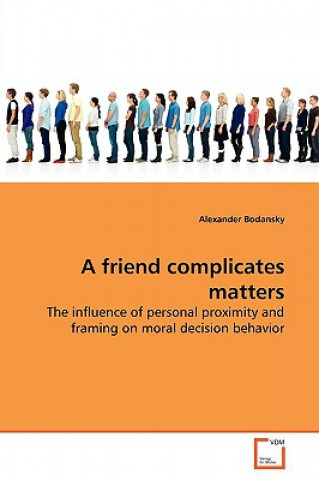
To explain decision behavior by reducing it to §utility maximization, as Kahneman and Tversky (2000) §do, or to intuitive behavior, as Gigerenzer (1996) §does, is to risk oversimplification. There is no §single definition of rational decision behavior. The §context defines what decision behavior can be §evaluated as rational. In the context of morality, §subjects base their decision behavior on four §different ethical positions: deontology, hedonism, §intuitionism and utilitarianism. In this article the §classical Asian disease problem (ADP), used by §Kahneman and Tversky (1981) to show the framing §effect, is understood as a moral dilemma. To reach a §decision, subjects relied to varying degrees on all §four ethical positions. Variation of the ADP`s §personal proximity influenced subjects decision §behavior, leading to the disappearance of the §framing effect, and changing the extent of subjects §reliance on the four ethical positions.


Informatie over het boek
Engels
Categorieën

Geef dit boek vandaag nog cadeau
Dat gaat heel eenvoudig
1 Voeg het boek toe aan je winkelwagentje en selecteer Als cadeau bezorgen 2 Je krijgt van ons per omgaand een voucher 3 Het boek wordt bezorgd op het adres van de ontvangerDit vind je misschien ook interessant









Hoi! Ik ben Libroamiko, je boekadviseur.
Hoe kan ik je helpen?