
 Contact
 Hoe winkelen bij ons werkt
Bezorging
Winkelgids
Acoustic Microscopy
 Engels
 454 b
454 b
Retourneren binnen 30 dagen
Klanten kochten ook








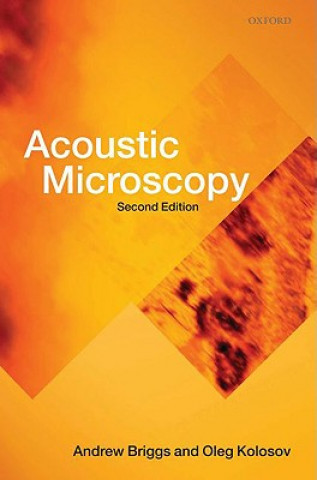
Acoustic microscopy enables the elastic properties of materials to be imaged and measured with the resolution of a good microscope. By using frequencies in the microwave regime, it is possible to make the acoustic wavelength comparable with the wavelength of light, and hence to achieve a resolution comparable with an optical microscope. Solids can support both longitudinal and transverse acoustic waves. At surfaces a unique combination of the two known as Raleigh waves can propagate, and in many circumstances these dominate the contrast in acoustic microscopy. Following the invention of scanning probe microscopes, it is now possible to use an atomic force microscope to detect the acoustic vibration of a surface with resolution in the nanometre range, thus beating the diffraction limit by operating in the extreme near-field. This second edition of Acoustic Microscopy has a major new chapter on the technique and applications of acoustically excited probe microscopy.


Informatie over het boek
Engels

Geef dit boek vandaag nog cadeau
Dat gaat heel eenvoudig
1 Voeg het boek toe aan je winkelwagentje en selecteer Als cadeau bezorgen 2 Je krijgt van ons per omgaand een voucher 3 Het boek wordt bezorgd op het adres van de ontvangerDit vind je misschien ook interessant






















 /
/
 Gebonden (paperback)
 16.50
€
16.50
€
Hoi! Ik ben Libroamiko, je boekadviseur.
Hoe kan ik je helpen?