
 Contact
 Hoe winkelen bij ons werkt
Bezorging
Winkelgids
AI Agent Security Engineering
Build, Test, and Defend Autonomous AI Agents Against Prompt Injection, Tool Abuse, Data Leakage, and Emerging Threats
 Engels
 63 b
63 b
 Nieuw
Nieuw
Tot 30 dagen retourrecht

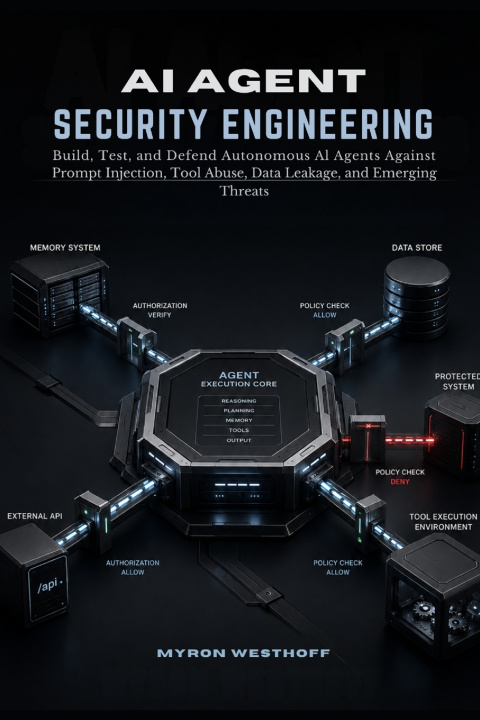
AI Agent Security Engineering: Build, Test, and Defend Autonomous AI Agents Against Prompt Injection, Tool Abuse, Data Leakage, and Emerging Threats
What happens when an AI agent does more than generate an incorrect answer? What if it follows a malicious instruction hidden inside a document, misuses a connected tool, exposes sensitive data, or performs an action the user was never authorized to request?
As AI agents gain access to APIs, databases, memory, RAG systems, MCP servers, external services, and other agents, traditional application security is no longer enough. AI Agent Security Engineering provides a practical guide to understanding and reducing the security risks created by autonomous, tool-connected AI systems.
Written for developers, AI engineers, security professionals, architects, and technical teams, this book explains AI agent security in clear language without burying you in unnecessary theory. You will learn how to identify attack surfaces, build practical threat models, defend against direct and indirect prompt injection, prevent tool abuse and excessive agency, protect sensitive data and agent memory, secure RAG pipelines, manage credentials, and control agent-to-agent trust.
You will also learn how to test and red-team AI agents, design layered defenses with authentication, authorization, least privilege, guardrails, sandboxing, and human approval, and detect suspicious behavior through logging and observability. The final chapters show you how to respond to security incidents, continuously test your defenses, and prepare AI agents for secure production deployment.
Practical examples, security testing techniques, threat-modeling templates, checklists, and production-readiness references help you turn the concepts into controls you can apply to real AI systems.
AI agents are becoming more capable, but greater autonomy also creates greater security responsibility. Building security after deployment can leave dangerous gaps in systems that already have access to valuable data and powerful tools.
Build agents that are not only intelligent, but controlled, testable, and defensible. Get your copy of AI Agent Security Engineering today and start engineering security into every layer of your autonomous AI systems.


Informatie over het boek
Engels
