
 Contact
 Hoe winkelen bij ons werkt
Bezorging
Winkelgids
 Engels
 25 b
25 b
 Nieuw
Nieuw
Tot 30 dagen retourrecht

You've seen his work. You don't know his name.
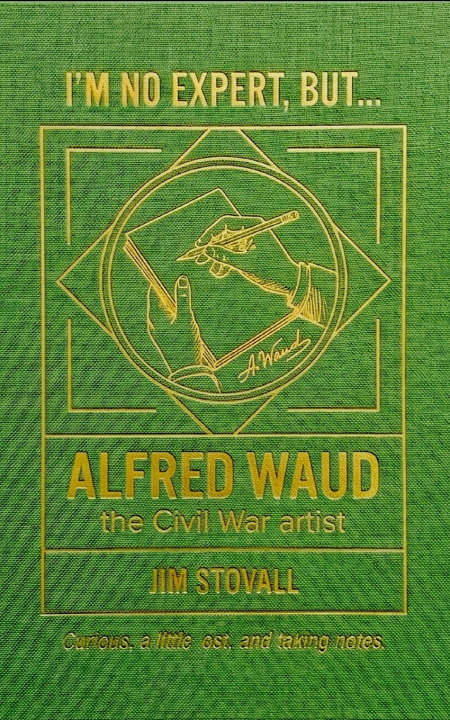
There is a photograph taken at Gettysburg in July 1863 that you may have encountered without realizing it. A bearded man in a wide-brimmed hat sits on a rock in the Devil's Den, sketchbook balanced on one knee. He looks completely at ease - the ease of someone accustomed to difficult places. His name is Alfred Waud. And almost nobody knows who he is.For four years, Waud followed the Army of the Potomac through every major battle of the Civil War - from First Bull Run to the Siege of Petersburg. His sketches, rushed by courier to New York and converted to woodcut engravings, appeared weekly in Harper's Weekly, the most widely read publication in America. In a nation with no photographs in print, no radio, no television, Waud's eyes were among the primary means by which ordinary Americans understood what the war looked like.
Matthew Brady gets the credit. Brady's cameras, as it turns out, could not do what Waud's pencil could. And the story of why - and of what happened to the man who actually showed America its war - is one of the most surprising in the history of American journalism.
SEVEN THINGS YOU SHOULD KNOW ABOUT ALFRED WAUD:
He wasn't American. The man who defined how the Union visualized its own Civil War was born in London and was not a U.S. citizen for the entire duration of the conflict.
Photography couldn't capture the war. Civil War cameras required exposures of several seconds, couldn't freeze motion, and - crucially - newspapers had no way to print photographs until 1880. The pencil wasn't the backup plan. It was the only plan.
There were only about thirty of them. The entire visual record of the Civil War rested on fewer than thirty "special artists" working in the field at any time - the first pictorial war correspondents in history.
What you saw wasn't what he drew. The public never saw Waud's actual work. What they saw were re-engravings made by craftsmen in New York. The originals were considered disposable and most were thrown away.
He was everywhere - and he was a target. He attended every battle of the Army of the Potomac without a single break, spent ninety minutes in a signal tree sketching Confederate positions while sharpshooters fired at him, and was never a noncombatant in Confederate eyes.He drew the only eyewitness account of Pickett's Charge. Of all the artists and photographers present at Gettysburg, only Waud was in position to draw the charge as it happened. His sketch is the closest visual record of that moment that exists.
He was almost lost, and he is almost forgotten. Most of his drawings were discarded. The Library of Congress collection - the largest surviving group - exists because of a single donation in 1919. Waud died in 1891 still sketching Civil War battlefields. Brady became famous. Waud did not.
I'm No Expert, But: Alfred Waud is part of the I'm No Expert, But series - short, accurate, accessible books about subjects that reward curiosity. Each volume can be read in thirty to forty-five minutes. Each one will leave you knowing something you didn't know before.


Informatie over het boek
Engels

Geef dit boek vandaag nog cadeau
Dat gaat heel eenvoudig
1 Voeg het boek toe aan je winkelwagentje en selecteer Als cadeau bezorgen 2 Je krijgt van ons per omgaand een voucher 3 Het boek wordt bezorgd op het adres van de ontvangerHoi! Ik ben Libroamiko, je boekadviseur.
Hoe kan ik je helpen?