
 Contact
 Hoe winkelen bij ons werkt
Bezorging
Winkelgids
Architecting Agentic AI
Architecture Principles, Design Patterns & Well Architected Framework
 Engels
 72 b
72 b
 Wordt verwacht
 Nieuw
Nieuw
Tot 30 dagen retourrecht

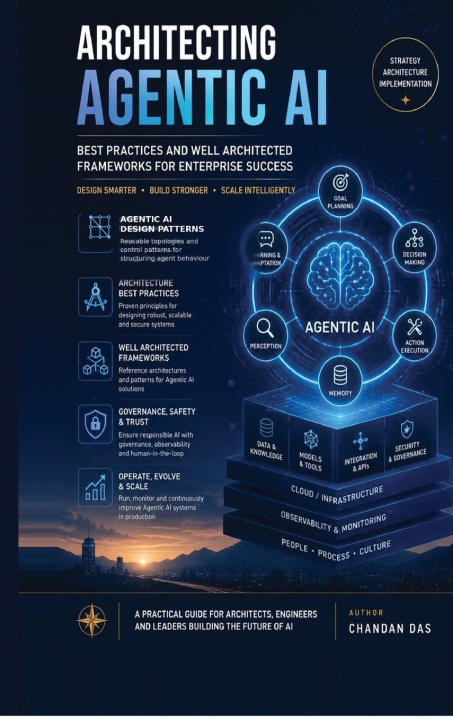
Most agentic systems do not fail because the model was not clever enough. They fail because a tool description was ambiguous enough to route the wrong way, because a loop had no defined way to stop, or because a credential was scoped to the agent instead of the task.These are not new problems. They are the classical problems of distributed systems, identity, authorisation and auditability, arriving in unfamiliar clothing and meeting teams who have been told the interesting part is the prompt.An agentic system is one in which a probabilistic component influences runtime control flow and real-world actions. That single property creates nearly every new architectural problem it faces, and the answer is not better prompting. It is placing authority outside the model: in deterministic validation, in policy the loop cannot reach, in ceilings it cannot raise, and in evidence written before an action, not after.Chandan Das offers a reference and an assurance instrument for the architects, platform leads and security teams who must put agents into production and defend the design afterwards. Eleven pillars. Thirty-seven numbered principles. A reference architecture, a pattern catalogue, a unified threat model, three worked designs, a maturity model, and a seventy-two-question architecture review.It is opinionated by intention. Where a choice is situational, it says so and names the deciding axis. Where the field has learned something expensively, it states the rule plainly.


Informatie over het boek
Engels

Geef dit boek vandaag nog cadeau
Dat gaat heel eenvoudig
1 Voeg het boek toe aan je winkelwagentje en selecteer Als cadeau bezorgen 2 Je krijgt van ons per omgaand een voucher 3 Het boek wordt bezorgd op het adres van de ontvangerHoi! Ik ben Libroamiko, je boekadviseur.
Hoe kan ik je helpen?