
 Contact
 Hoe winkelen bij ons werkt
Bezorging
Winkelgids
 Engels
 113 b
113 b
 Wordt verwacht
 Nieuw
Nieuw
Tot 30 dagen retourrecht

AI systems do not fail the way traditional software does.
- They fail quietly.
- They fail creatively.
- And sometimes, they fail while confidently telling you everything is fine.
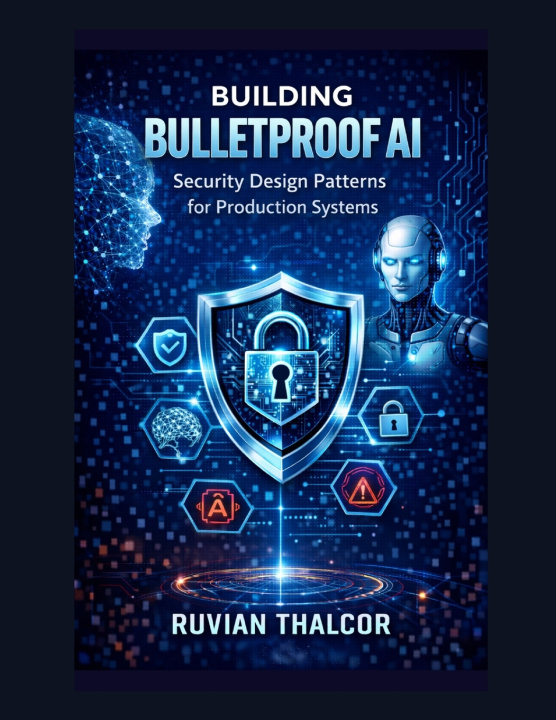
Building Bulletproof AI is not about building perfectly secure AI. That idea does not survive first contact with production. This book is about building AI systems that expect failure, survive abuse, limit damage, and recover gracefully - even when models hallucinate, prompts drift, tools misbehave, and users do unexpected things.
This book answers that question.
Security lives in architecture. Not in the model. Not in the prompt. Not in a policy document. In the entire system - and how it is designed to behave when things go wrong. Inside, you will learn the production-ready security design patterns that separate resilient AI systems from fragile ones:
Input and Output Isolation - how to treat every prompt as security-critical configuration and every model response as an untrusted, potentially dangerous interface
Tool Capability Control - how to design permissioned tool access that enforces least privilege and survives adversarial manipulation without breaking agent functionality
Memory and State Security - how to treat agent memory as a high-risk asset, control what gets stored and retrieved, and prevent memory from becoming a persistence mechanism for attackers
Trust Boundary Design - where to draw hard lines between components, how to enforce them structurally rather than through policy, and why soft trust assumptions always get exploited first
Blast Radius Reduction - how to scope failure so that a compromised component, a manipulated prompt, or a misbehaving model cannot cascade into a system-wide incident
Identity and Secrets Management - how AI systems should handle credentials, API keys, and user identity - and why inheriting ambient permissions is one of the most common production mistakes
Observability from Day One - how to instrument AI systems for behavioral monitoring, anomaly detection, and incident reconstruction before an incident forces you to
Safe Degradation Patterns - how to design systems that fail gracefully under pressure rather than collapsing in ways that expose users, data, or downstream systems
Secure Prompt Architecture - how to structure system prompts, user inputs, and retrieved context as security boundaries rather than free-form text fields
Resilience Under Abuse - how to design for misuse, cost exhaustion, denial of service, and adversarial edge cases that functional testing never catches
Building Bulletproof AI is Book 8 in the series:
The AI Security & Hacking Bible: Protect and Exploit LLMs and Autonomous Agents
If you have read LLM Security in Practice and AI Threat Modeling, this book builds directly on that foundation. If you have worked through Red Teaming LLMs, Hardening AI Agents, and The AI Agent Attacker's Playbook, this book is where everything you learned about how systems break becomes the blueprint for how to build them so they do not. AI Security Operations Guide and 10 Real AI Security Incidents follow with the operational and forensic perspective - but everything they monitor and respond to starts with the architectural decisions made here.
This book is for you if you are a:
Software architect designing LLM-powered or agent-based systems for production deployment
Security engineer moving from reactive incident response toward proactive architectural defense
Developer who has read enough about what can go wrong and now needs to know how to build it right
Engineering leader responsible for the security posture


Informatie over het boek
Engels

Geef dit boek vandaag nog cadeau
Dat gaat heel eenvoudig
1 Voeg het boek toe aan je winkelwagentje en selecteer Als cadeau bezorgen 2 Je krijgt van ons per omgaand een voucher 3 Het boek wordt bezorgd op het adres van de ontvangerHoi! Ik ben Libroamiko, je boekadviseur.
Hoe kan ik je helpen?