Contact
 Hoe winkelen bij ons werkt
Bezorging
Winkelgids
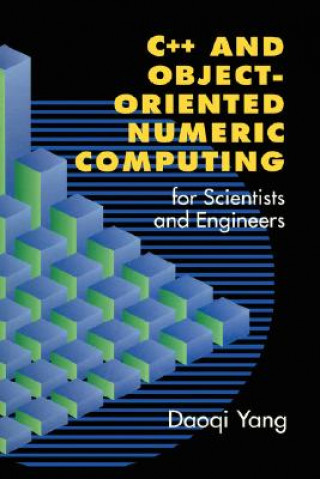
C++ and Object-Oriented Numeric Computing for Scientists and Engineers
 Engels
 220 b
220 b
Retourneren binnen 30 dagen
Klanten kochten ook

 /
/
 Gebonden (paperback)
 55.27
€
55.27
€

 /
Gebonden (harde band)
26.87
€
/
Gebonden (harde band)
26.87
€
 /
Gebonden (paperback)
24.04
€
/
Gebonden (paperback)
24.04
€



 /
Gebonden (paperback)
122.16
€
/
Gebonden (paperback)
122.16
€












This new text/reference presents an accessible, concise, but rather complete, introduction to the C++ programming language with special emphasis on object-oriented numeric computation for scientific and engineering program development. The description of the language is in compliance with ISO/ANSI standards and is platform independent for maximum versatility. Requiring only basic calculus and linear algebra as prerequisites, the book introduces concepts, techniques, and standard libraries of C++ in a manner that is easy to understand and uses such familiar examples as vectors, matrices, integrals, and complex numbers. It also contains an introduction to C++ programs for applications with many numeric methods that are fundamental to science and engineering computing: polynomial evaluation and interpolation; numeric integration; methods for solving nonlinear equations; systems of linear equations in full, band, an d sparse matrix storage formats and ordinary and partial differential equations. Numerous techniques and examples are provided on how to reduce (C and Fortran) run-time overhead and improve program efficiency.This new text/reference presents an accessible, concise, but rather complete, introduction to the C++ programming language with special emphasis on object-oriented numeric computation for scientific and engineering program development. The description of the language is in compliance with ISO/ANSI standards and is platform independent for maximum versatility.Requiring only basic calculus and linear algebra as prerequisites, the book introduces concepts, techniques, and standard libraries of C++ in a manner that is easy to understand and uses such familiar examples as vectors, matrices, integrals, and complex numbers. It also contains an introduction to C++ programs for applications with many numeric methods that are fundamental to science and engineering computing: polynomial evaluation and interpolation; numeric integration; methods for solving nonlinear equations; systems of linear equations in full, band, and sparse matrix storage formats; and ordinary and partial differential equations. Numerous techniques and examples are provided on how to reduce (C and Fortran) run-time overhead and improve program efficiency.


Informatie over het boek
Engels
Categorieën

Geef dit boek vandaag nog cadeau
Dat gaat heel eenvoudig
1 Voeg het boek toe aan je winkelwagentje en selecteer Als cadeau bezorgen 2 Je krijgt van ons per omgaand een voucher 3 Het boek wordt bezorgd op het adres van de ontvangerDit vind je misschien ook interessant







 /
Gebonden (paperback)
14.74
€
/
Gebonden (paperback)
14.74
€
 /
Gebonden (paperback)
15.75
€
/
Gebonden (paperback)
15.75
€


 /
Gebonden (harde band)
38.19
€
/
Gebonden (harde band)
38.19
€









 /
Gebonden (paperback)
11.61
€
/
Gebonden (paperback)
11.61
€