
 Contact
 Hoe winkelen bij ons werkt

Bezorging
Winkelgids
 Engels
 47 b
 Wordt verwacht
 Nieuw
 Wordt voor Kerst bezorgd ▾
Naar verwachting op voorraad
Op voorraad op 17. 11. 2026
Tot 30 dagen retourrecht

Four light-years. Decades of flight. A destination that could change how we understand our place in the universe.
What would it really take to reach another star?
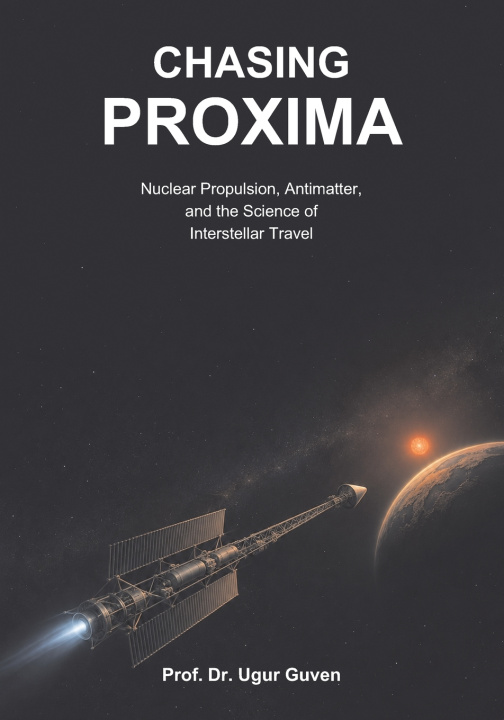
In Chasing Proxima: Nuclear Propulsion, Antimatter, and the Science of Interstellar Travel, Prof. Dr. Ugur Guven invites you aboard a hypothetical mission to our nearest stellar neighbour. From the first decisions made on Earth to the arrival of a signal from another planetary system, this illustrated scientific journey follows the questions that any interstellar spacecraft would have to answer.
The destination is Proxima Centauri, a small, active red dwarf in the wider Alpha Centauri system. Around it orbit planets that have captured the imagination of scientists and space enthusiasts. But a planet in a potentially temperate orbit is not automatically another Earth. Does Proxima b have an atmosphere? Could conditions permit liquid water? What could an approaching spacecraft measure, and which mysteries would remain?
Before we can investigate those questions, we must cross the space between stars.
Explore how nuclear thermal rockets, nuclear electric propulsion, pulse engines and fusion concepts turn energy into motion. Discover why antimatter is so compelling, why its extraordinary energy density does not guarantee a practical starship, and why production, storage, magnetic nozzles and waste heat belong in the same conversation as speed.
Then follow the ship into the crossing. At a substantial fraction of light speed, even a tiny dust grain becomes an engineering challenge. Radiation threatens instruments and electronics. Components must endure for decades. Navigation must anticipate where the destination will be, while a message to Earth can take more than four years to arrive.
Who makes the decisions when help cannot reach the spacecraft in time?
The journey also brings relativity into focus. Compare the time recorded on Earth with the time experienced aboard the ship. See why acceleration and braking change the mission timetable, how motion shifts the light entering a camera, and why dramatic claims about faster-than-light travel can arise from confusing different definitions of velocity.
Arrival presents another challenge: slowing down. A spacecraft that rushes past a star has achieved something very different from an observatory that can remain and study its planets. The book examines that distinction, then considers how a mission could investigate stellar activity, atmospheric chemistry, planetary temperatures and possible signs of life.
Throughout, observations are distinguished from assumptions. Hypothetical planetary environments are explored as possibilities, not presented as discoveries. Fusion and antimatter propulsion are examined with both scientific curiosity and attention to their unresolved engineering demands.
With 28 chapters, 20 original diagrams, 13 tables, worked examples, a glossary and references, Chasing Proxima makes demanding ideas approachable without removing the physics that gives them meaning. Explanations connect equations to the decisions behind a mission: how much mass to carry, how much power to supply, what to protect and which observations deserve the first photons sent home.
Written for curious readers, students, educators and space enthusiasts, this book offers a way to think beyond familiar rocket launches and planetary missions. You do not need to be a propulsion specialist to follow the argument. Bring your curiosity and let each chapter reveal another part of the challenge.
If we decide to reach another star, what kind of spacecraft-and what kind of commitment-will the journey demand?
The first step toward the stars is understanding the journey between our world and theirs.


Informatie over het boek
Engels

Geef dit boek vandaag nog cadeau
Dat gaat heel eenvoudig
1 Voeg het boek toe aan je winkelwagentje en selecteer Als cadeau bezorgen 2 Je krijgt van ons per omgaand een voucher 3 Het boek wordt bezorgd op het adres van de ontvangerHoi! Ik ben Libroamiko, je boekadviseur.
Hoe kan ik je helpen?