
 Contact
 Hoe winkelen bij ons werkt
Bezorging
Winkelgids
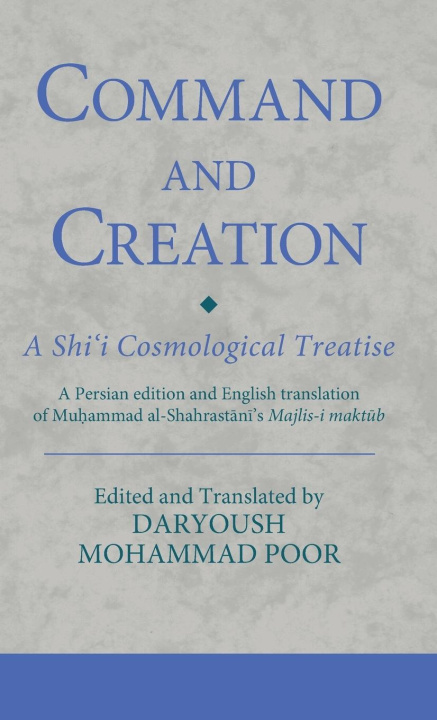
Command and Creation: A Shi'i Cosmological Treatise
 Engels
 275 b
275 b
Retourneren binnen 30 dagen
Klanten kochten ook

 /
/
 Gebonden (harde band)
 37.87
€
37.87
€


 /
Gebonden (paperback)
45.87
€
/
Gebonden (paperback)
45.87
€


 /
Gebonden (paperback)
18.42
€
/
Gebonden (paperback)
18.42
€


 Gebonden (harde band)
83.04
€
Gebonden (harde band)
83.04
€

 /
Gebonden (paperback)
48.10
€
/
Gebonden (paperback)
48.10
€


 /
Gebonden (paperback)
6.78
€
/
Gebonden (paperback)
6.78
€





 /
Gebonden (paperback)
10.83
€
/
Gebonden (paperback)
10.83
€

Among the considerable oeuvre of Muhammad al-Shahrastani (1086-1153), the prominent Persian theologian and heresiographer, the Majlis-i maktub ('The Transcribed Sermon') is his only known work in Persian. First delivered as a sermon in Khwarazm in Central Asia, this treatise invokes the theme of creation and command, providing an esoteric cosmological narrative where faith, revelation, prophecy and the spiritual authority of the Household of the Prophet are interwoven. The Majlis-i maktub further discusses themes such as the evolution of religious law (shari'at) and its culmination in the qiyamat(resurrection), the relation between free will and predestination, the interplay between the exoteric and esoteric aspects of faith, and the role and function of the Shi?i Imams in the cosmological narrative.
This treatise is arguably the most dense expression of al-Shahrastani's thought, and it demonstrably indicates the Ismaili inclination of this Muslim scholar who has usually been regarded as a Shafi'i-Ash'ari. Daryoush Mohammad Poor's comparative study of this treatise and the corpus of Nizari Ismaili literature from the Alamut period (1090-1256) reveals the massive impact of al-Shahrastani's thought on every aspect of the doctrines of Nizari Ismailis.


Informatie over het boek
Engels

Geef dit boek vandaag nog cadeau
Dat gaat heel eenvoudig
1 Voeg het boek toe aan je winkelwagentje en selecteer Als cadeau bezorgen 2 Je krijgt van ons per omgaand een voucher 3 Het boek wordt bezorgd op het adres van de ontvangerDit vind je misschien ook interessant


 /
Gebonden (paperback)
7.69
€
/
Gebonden (paperback)
7.69
€


 /
Gebonden (paperback)
105.53
€
/
Gebonden (paperback)
105.53
€

 /
Gebonden (paperback)
28.35
€
/
Gebonden (paperback)
28.35
€





 /
Gebonden (paperback)
38.27
€
/
Gebonden (paperback)
38.27
€
 /
Gebonden (paperback)
26.42
€
/
Gebonden (paperback)
26.42
€

Hoi! Ik ben Libroamiko, je boekadviseur.
Hoe kan ik je helpen?