
 Contact
 Hoe winkelen bij ons werkt
Bezorging
Winkelgids
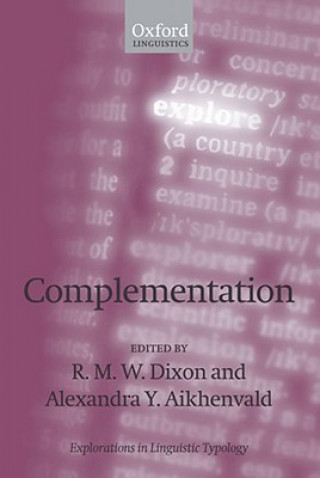
Complementation
 Engels
 206 b
206 b
Retourneren binnen 30 dagen
Klanten kochten ook
 /
/
 Gebonden (paperback)
 28.28
€
28.28
€

 /
Gebonden (paperback)
17.98
€
/
Gebonden (paperback)
17.98
€




 /
Gebonden (paperback)
27.58
€
/
Gebonden (paperback)
27.58
€





 /
Gebonden (paperback)
14.74
€
/
Gebonden (paperback)
14.74
€

A complement clause is used instead of a noun phrase; for example one can say either I heard [the result] or I heard [that England beat France]. Languages differ in the grammatical properties of complement clauses, and the types of verbs which take them. Some languages lack a complement clause construction but instead employ other construction types to achieve similar ends; these are called complementation strategies. The book explores the variety of types of complementation found across the languages of the world, their grammatical properties and meanings. Detailed studies of particular languages, including Akkadian, Israeli, Jarawara, and Pennsylvania German, are framed by R. M. W. Dixon's introduction, which sets out the range of issues, and his conclusion, which draws together the evidence and the arguments. This book will interest scholars of typology, language universals, syntax, information structure, and language contact in departments of linguistics and anthropology, as well as advanced and graduate students taking courses in these subjects.


Informatie over het boek
Engels
Categorieën

Geef dit boek vandaag nog cadeau
Dat gaat heel eenvoudig
1 Voeg het boek toe aan je winkelwagentje en selecteer Als cadeau bezorgen 2 Je krijgt van ons per omgaand een voucher 3 Het boek wordt bezorgd op het adres van de ontvangerDit vind je misschien ook interessant




 /
Gebonden (paperback)
6.76
€
/
Gebonden (paperback)
6.76
€
 /
Gebonden (paperback)
10.30
€
/
Gebonden (paperback)
10.30
€
 /
Gebonden (paperback)
53.85
€
/
Gebonden (paperback)
53.85
€



 /
Gebonden (harde band)
139.14
€
/
Gebonden (harde band)
139.14
€