
 Contact
 Hoe winkelen bij ons werkt
Bezorging
Winkelgids
Composite Systems Decisions
 Engels
 373 b
373 b
Retourneren binnen 30 dagen
Klanten kochten ook











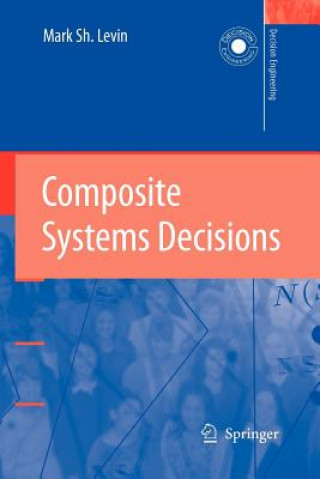
Composite decisions consist of interconnected parts or subdecisions and correspond to a composite (composable, modular, decomposable) system. The composite decision approach extends the traditional paradigm of decision making of Herbert A. Simon, i.e. choice of the best alternative(s), and realizes a two-stage solving scheme: (a) the selection of alternatives as the best subdecisions or local decisions and (b) composition of the selected local decisions into a composite global decision while taking into account the quality of the local decisions and their compatibility. §Composite Systems Decisions describes an educational approach that is based on systems engineering and considered modular design of composite decisions. Divided into four parts, this book contains descriptions of basic systems approaches and examines basic technological problems for composite systems, including: modular hierarchical design; multistage design; multistage planning; redesign/improvement/adaptation; evaluation; and, combinatorial evolution/development. §Applied researchers, undergraduate and graduate students, and practitioners in many domains will find Composite Systems Decisions a valuable reference. The basic systems problems, solving schemes, and applied examples contained in the book will also be of interest to various scientists (e.g., mathematicians, computer scientists, economists, social engineers, etc.).Composite decisions are decisions consisting of interconnected parts (subdecisions) and they correspond to a composite (composable, modular, decomposable) system. The material will be of interest to scientists (e.g., mathematicians, computer scientists, economists, social engineers,etc.). The book can be used as a text for courses (for example: systems engineering, system design, life cycle engineering, engineering design, combinatorial synthesis) at the level of undergraduate (a compressed version), graduate/PhD levels and for continuing education.Composite decisions consist of interconnected parts or subdecisions and correspond to a composite (composable, modular, decomposable) system. The composite decision approach extends the traditional paradigm of decision making of Herbert A. Simon, i.e. choice of the best alternative(s), and realizes a two-stage solving scheme: (a) the selection of alternatives as the best subdecisions or local decisions and (b) composition of the selected local decisions into a composite global decision while taking into account the quality of the local decisions and their compatibility. §Composite Systems Decisions describes an educational approach that is based on systems engineering and considered modular design of composite decisions. Divided into four parts, this book contains descriptions of basic systems approaches and examines basic technological problems for composite systems, including: modular hierarchical design; multistage design; multistage planning; redesign/improvement/adaptation; evaluation; and, combinatorial evolution/development. §Applied researchers, undergraduate and graduate students, and practitioners in many domains will find Composite Systems Decisions a valuable reference. The basic systems problems, solving schemes, and applied examples contained in the book will also be of interest to various scientists (e.g., mathematicians, computer scientists, economists, social engineers, etc.). §The Decision Engineering series focuses on the foundations and applications of tools and techniques related to decision engineering, and identifies their relevance in engineering decisions. The series provides an aid to practising professionals and applied researchers in the development of tools for informed operational and business decision making, within industry, by utilising distributed organisational knowledge.


Informatie over het boek
Engels
Categorieën

Geef dit boek vandaag nog cadeau
Dat gaat heel eenvoudig
1 Voeg het boek toe aan je winkelwagentje en selecteer Als cadeau bezorgen 2 Je krijgt van ons per omgaand een voucher 3 Het boek wordt bezorgd op het adres van de ontvangerDit vind je misschien ook interessant







 /
/
 Gebonden (harde band)
 234.86
€
234.86
€

Hoi! Ik ben Libroamiko, je boekadviseur.
Hoe kan ik je helpen?