Contact
 Hoe winkelen bij ons werkt
Bezorging
Winkelgids
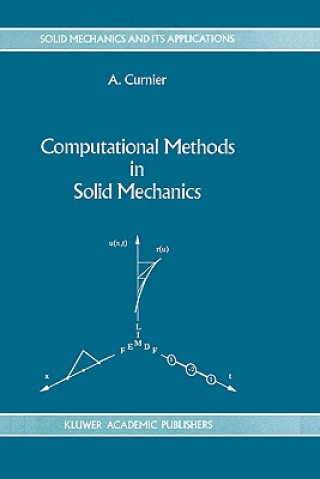
Computational Methods in Solid Mechanics
 Engels
 498 b
498 b
Retourneren binnen 30 dagen
Klanten kochten ook



 /
/
 Gebonden (paperback)
 26.16
€
26.16
€










 /
Gebonden (paperback)
14.54
€
/
Gebonden (paperback)
14.54
€


This volume presents an introduction to the three numerical methods most commonly used in the mechanical analysis of deformable solids, viz. the finite element method (FEM), the linear iteration method (LIM), and the finite difference method (FDM). The book has been written from the point of view of simplicity and unity; its originality lies in the comparable emphasis given to the spatial, temporal and nonlinear dimensions of problem solving. This leads to a neat global algorithm. Chapter 1 addresses the problem of a one-dimensional bar, with emphasis being given to the virtual work principle. Chapters 2--4 present the three numerical methods. Although the discussion relates to a one-dimensional model, the formalism used is extendable to two-dimensional situations. Chapter 5 is devoted to a detailed discussion of the compact combination of the three methods, and contains several sections concerning their computer implementation. Finally, Chapter 6 gives a generalization to two and three dimensions of both the mechanical and numerical aspects. For graduate students and researchers whose work involves the theory and application of computational solid mechanics.


Informatie over het boek
Engels
Categorieën

Geef dit boek vandaag nog cadeau
Dat gaat heel eenvoudig
1 Voeg het boek toe aan je winkelwagentje en selecteer Als cadeau bezorgen 2 Je krijgt van ons per omgaand een voucher 3 Het boek wordt bezorgd op het adres van de ontvangerDit vind je misschien ook interessant
 /
Gebonden (harde band)
136.82
€
/
Gebonden (harde band)
136.82
€

 /
Gebonden (paperback)
9.39
€
/
Gebonden (paperback)
9.39
€

 /
Gebonden (harde band)
36.37
€
/
Gebonden (harde band)
36.37
€



 /
Gebonden (paperback)
19.29
€
/
Gebonden (paperback)
19.29
€

 /
Gebonden (paperback)
54.76
€
/
Gebonden (paperback)
54.76
€

 /
Gebonden (paperback)
20.30
€
/
Gebonden (paperback)
20.30
€

 /
Gebonden (harde band)
22.12
€
/
Gebonden (harde band)
22.12
€