
 Contact
 Hoe winkelen bij ons werkt

Bezorging
Winkelgids
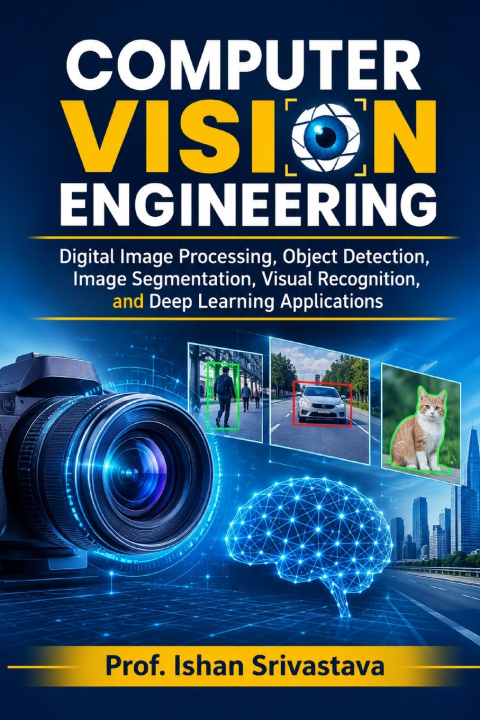
Computer Vision Engineering
Digital Image Processing, Object Detection, Image Segmentation, Visual Recognition, and Deep Learning Applications
 Engels
 46 b
 Wordt verwacht
 Nieuw
Tot 30 dagen retourrecht

Few technologies have changed as quickly, or as visibly, as computer vision. A little over a decade ago, recognising a thousand everyday object categories in photographs was a research frontier; today the same capability runs on a mobile phone, and systems that segment arbitrary objects from a short text prompt, read medical scans, guide vehicles and inspect factory products are routine engineering components. Yet the speed of progress has left a gap. Researchers publish new architectures every week, practitioners assemble pipelines from pre-trained models, and students are often asked to learn either the classical theory of image formation and geometry or the latest deep networks, but rarely both in one coherent account. This book was written to close that gap.
Computer Vision Engineering treats the field as an engineering discipline. An engineer must understand how light becomes pixels, how those pixels can be cleaned and analysed with well-founded mathematics, how learned models extract meaning from them, and how the resulting systems are specified, evaluated, deployed and maintained in the real world. The book therefore follows the complete life cycle of a vision system: from image acquisition and digital image processing, through feature extraction and geometry, to deep learning for visual recognition, object detection and image segmentation, and finally to data engineering, optimisation for edge devices, monitoring, ethics and robustness.
Who this book is for
The text is intended for senior undergraduate and graduate students of computer science, electronics and communication, electrical, mechanical, biomedical and data-science programmes, and for practising engineers who wish to move from using libraries to understanding them. A working knowledge of linear algebra, calculus, probability and basic programming in Python is assumed; Appendix A reviews the mathematics that is used most often. No prior exposure to image processing or neural networks is required.
Approach and philosophy
Four principles guided the writing.
- Foundations first. Deep learning did not make classical vision obsolete. Convolution, sampling, the pinhole camera, gradients, epipolar geometry and statistical decision theory appear again and again inside modern systems, and engineers who understand them diagnose failures faster.
- Engineering over fashion. Architectures come and go; trade-offs endure. For every method the book explains the problem it solves, its assumptions, its cost in computation and data, and the conditions under which it breaks.
- Show, do not only tell. Every chapter contains diagrams, tables and worked examples. Many figures are computed directly from small synthetic images so that the reader can reproduce them in a few lines of code.
- Responsible practice. Vision systems observe people and make decisions about them. Questions of bias, privacy, safety and explainability are therefore woven into the technical chapters and gathered in the final chapter.


Informatie over het boek
Engels

Geef dit boek vandaag nog cadeau
Dat gaat heel eenvoudig
1 Voeg het boek toe aan je winkelwagentje en selecteer Als cadeau bezorgen 2 Je krijgt van ons per omgaand een voucher 3 Het boek wordt bezorgd op het adres van de ontvangerHoi! Ik ben Libroamiko, je boekadviseur.
Hoe kan ik je helpen?