
 Contact
 Hoe winkelen bij ons werkt
Bezorging
Winkelgids
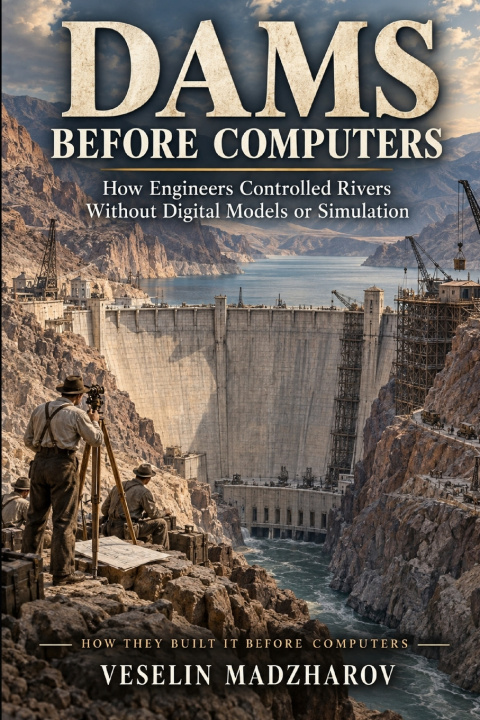
DAMS BEFORE COMPUTERS
How Engineers Controlled Rivers Without Digital Models or Simulation
 Engels
 60 b
60 b
 Nieuw
Nieuw
Tot 30 dagen retourrecht

Before computers could simulate floods, calculate structural stresses in seconds, or model the behavior of an entire river system, engineers were already building some of the largest and most ambitious structures on Earth.
Dams Before Computers tells the story of how engineers learned to control rivers using mathematics, physical models, surveying, field measurements, mechanical instruments, and engineering judgment.
Building a major dam was never simply a matter of placing concrete across a valley. Engineers had to understand the river, the geology beneath it, the pressure of millions of tons of stored water, the stability of foundations, and the destructive power of floods. They had to predict how water would behave through spillways, tunnels, gates, and outlets-often with limited data and no digital simulation.
The answers came through painstaking calculation and experiment.
Engineers worked with slide rules, logarithmic tables, hand-drawn plans, mechanical calculators, and empirical formulas developed from earlier projects. Surveyors mapped valleys with optical instruments. Geologists investigated rock formations with limited drilling technology. Hydraulic laboratories built large physical models of rivers, spillways, and dam structures so that engineers could observe flow patterns directly and test ideas before construction began.
This book explores the methods behind gravity dams, arch dams, buttress dams, spillways, diversion tunnels, and reservoir systems built during the great pre-digital era of civil engineering. It examines how engineers calculated water pressure, uplift, stability, concrete stresses, flood discharge, and structural behavior without finite-element analysis or computational fluid dynamics.
It also looks at the enormous practical challenge of construction. Remote valleys had to become industrial sites. Roads, railways, cableways, concrete plants, quarries, worker camps, and power systems were built before the dam itself could rise. Millions of tons of material had to be moved and placed with extraordinary precision.
Inside you will discover how engineers:
• selected dam sites and investigated foundations
• calculated hydraulic and structural loads by hand
• designed gravity and arch dams without digital analysis
• estimated floods from incomplete historical records
• developed spillways and outlet systems
• used physical scale models to study complex water flow
• surveyed valleys and reservoirs with mechanical instruments
• controlled concrete temperature, cracking, seepage, and uplift
• monitored dam movement before electronic sensor networks
• learned from failures, near failures, and successful landmark projects
The engineers of this era worked with tools that appear simple today, but the problems they faced were anything but simple. Their designs depended on careful observation, conservative assumptions, repeated calculation, experimentation, and a deep understanding of materials and natural forces.
Dams Before Computers is more than a history of large structures. It is a history of engineering reasoning-of how people solved problems when there was no software to provide an instant answer.
For engineers, technicians, students, and readers interested in civil engineering and the infrastructure that shaped the modern world, this book reveals how rivers were controlled and enormous dams were created long before digital models and simulation became part of everyday engineering.


Informatie over het boek
Engels

Geef dit boek vandaag nog cadeau
Dat gaat heel eenvoudig
1 Voeg het boek toe aan je winkelwagentje en selecteer Als cadeau bezorgen 2 Je krijgt van ons per omgaand een voucher 3 Het boek wordt bezorgd op het adres van de ontvangerHoi! Ik ben Libroamiko, je boekadviseur.
Hoe kan ik je helpen?