
 Contact
 Hoe winkelen bij ons werkt
Bezorging
Winkelgids
 Engels
 70 b
70 b
 Nieuw
Nieuw
Tot 30 dagen retourrecht

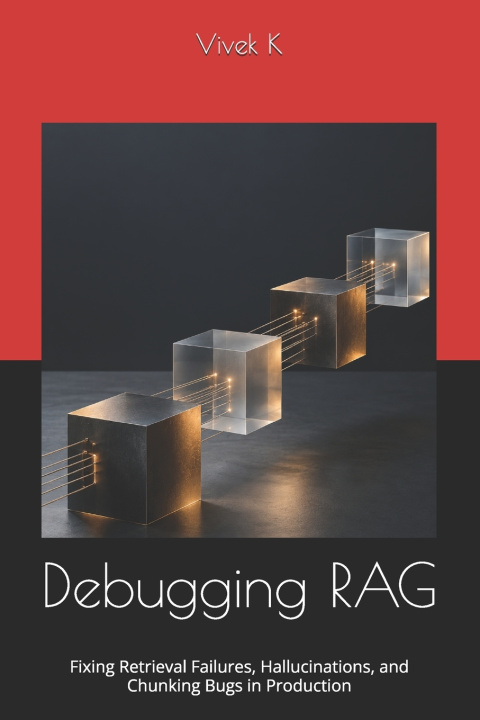
Stop Guessing Why Your RAG Pipeline Failed. Debug It with Mathematical Rigor.
You have a Retrieval-Augmented Generation (RAG) system running in production. Most of the time it works. Then an enterprise customer, compliance auditor, or VP reads an answer and asks: "Why did the assistant say that?"
You check your logs and find an HTTP 200 and a latency metric. You cannot see the raw query sent to the vector store, the candidate chunks, the serialized filters, or the exact prompt assembled. You test the query in staging and get a completely different answer. By 5:00 PM, five engineers are standing around a whiteboard guessing.
Debugging RAG is the diagnostic field manual that kills the guesswork.
Over 80% of ungrounded answers are not model hallucinations - they are upstream software defects: borderless tables mangled during extraction, condition clauses severed by naive chunkers, vector spaces distorted by unnormalized embeddings, and fusion windows that drop gold hits before the reranker ever executes.
What You Will Master Inside:- The Trace Is the Bug Report: Build OpenTelemetry span trees capturing HMAC-SHA256 chunk hashes, raw candidate scores, serialized vector filters, and exact rendered prompt bytes without leaking PII.
- The Oracle Ladder (6-Rung Bisection): Run a systematic 15-minute substitution algorithm (Oracle Context, Oracle Chunk, Oracle Query, Oracle Ranking, Oracle Prompt) to isolate any production failure to a single component.
- Forensic Ingestion: Stop silent parser data loss across multi-column PDF layouts, scanned amendments, and encoding corruptions (mojibake, ligatures, soft hyphens) using table linearization and confidence gates.
- The Nine Chunking Specimens: Detect and eliminate headless table rows, swallowed headings, orphaned pronouns, amputated lists, code fence bisections, and overlap ghosts with an automated linter (chunk_lint.py).
- The Vector Contract: Audit unit norms, detect silent embedding model swaps behind stable aliases, diagnose domain-distribution collapse, and prevent distance metric mismatches.
- Hybrid Search & Reranking: Combine lexical BM25 and dense retrieval using Reciprocal Rank Fusion (RRF), optimize fusion windows, and prevent reranker starvation.
- Context Assembly & Prompt Rot: Eliminate "lost-in-the-middle" attention degradation, manage token budgets, and resolve contradictory documents with deterministic revision headers.
- Metrics That Tell the Truth: Replace deceptive aggregate numbers with query-stratified test sets and baseline controls (the Parametric Floor, shuffled-context ablations, and random-index baselines).
Every procedure, SQL query, and configuration resolves against battle-tested tools: PostgreSQL 17 + pgvector, Qdrant, Elasticsearch 9.x, OpenSearch, LangChain, LlamaIndex, text-embedding-3-large, BGE-M3, Voyage-4, Cohere Rerank, OpenTelemetry, Arize Phoenix, Langfuse, Ragas, and DeepEval.
Who This Field Manual Is For:Written for AI engineers, ML platform engineers, software architects, and SREs who own the on-call pager and must explain why an assistant gave a wrong answer before the customer calls back.
Stop prompt tuning in the dark. Climb the ladder, eliminate the whiteboard arguments, and fix your pipeline.


Informatie over het boek
Engels

Geef dit boek vandaag nog cadeau
Dat gaat heel eenvoudig
1 Voeg het boek toe aan je winkelwagentje en selecteer Als cadeau bezorgen 2 Je krijgt van ons per omgaand een voucher 3 Het boek wordt bezorgd op het adres van de ontvangerHoi! Ik ben Libroamiko, je boekadviseur.
Hoe kan ik je helpen?