
 Contact
 Hoe winkelen bij ons werkt
Bezorging
Winkelgids
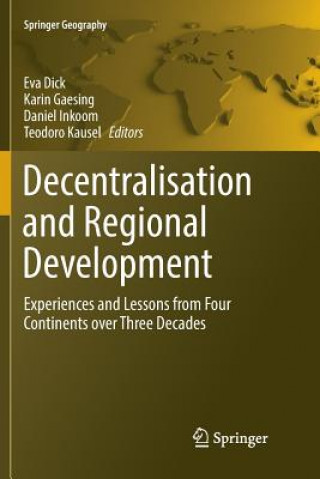
Decentralisation and Regional Development
Experiences and Lessons from Four Continents over Three Decades
 Engels
 249 b
249 b
Tot 30 dagen retourrecht
Klanten kochten ook








 /
/
 Gebonden (paperback)
 13.00
€
13.00
€























This book analyzes decentralisation, regional development paths and success factors in different governance sectors in Ghana, the Philippines, Tanzania and Chile, and discuss overarching aspects of relevance. Decentralisation, which refers to the delegation of administrative responsibilities, political decision-making and fiscal powers to lower levels of government, is now considered one of the most efficient engines of development. In Sub-Saharan Africa decentralised states have made more progress in reducing poverty than those states with lower decentralisation scores. But in many countries, decentralisation is still considered a 'work in progress' with unsatisfactory results. From a spatial point of view, the link between decentralisation and regional and district development is particularly interesting. Both in the North and in the South, regional or district development is seen as holding the potential for advancing social and economic development, and even more so in decentralised political settings. Space-based networks at the regional or district level are considered instrumental for responding to locally specific challenges, e.g. in areas lagging behind economically.


Informatie over het boek
Engels
Categorieën

Geef dit boek vandaag nog cadeau
Dat gaat heel eenvoudig
1 Voeg het boek toe aan je winkelwagentje en selecteer Als cadeau bezorgen 2 Je krijgt van ons per omgaand een voucher 3 Het boek wordt bezorgd op het adres van de ontvangerDit vind je misschien ook interessant
 /
Gebonden (paperback)
153.91
€
/
Gebonden (paperback)
153.91
€


 /
Gebonden (harde band)
22.28
€
/
Gebonden (harde band)
22.28
€

 /
Gebonden (paperback)
205.15
€
/
Gebonden (paperback)
205.15
€

 /
Gebonden (harde band)
129.00
€
/
Gebonden (harde band)
129.00
€




 /
Gebonden (paperback)
12.40
€
/
Gebonden (paperback)
12.40
€
 /
Gebonden (paperback)
9.37
€
/
Gebonden (paperback)
9.37
€


 /
Gebonden (paperback)
103.18
€
/
Gebonden (paperback)
103.18
€




 /
Gebonden (harde band)
45.98
€
/
Gebonden (harde band)
45.98
€



Hoi! Ik ben Libroamiko, je boekadviseur.
Hoe kan ik je helpen?