
 Contact
 Hoe winkelen bij ons werkt
Bezorging
Winkelgids
Dislocations, Mesoscale Simulations and Plastic Flow
 Engels
 348 b
348 b
Tot 30 dagen retourrecht
Klanten kochten ook



 /
/
 Gebonden (paperback)
 14.42
€
14.42
€
 /
Gebonden (paperback)
57.70
€
/
Gebonden (paperback)
57.70
€
 /
Gebonden (paperback)
28.24
€
/
Gebonden (paperback)
28.24
€

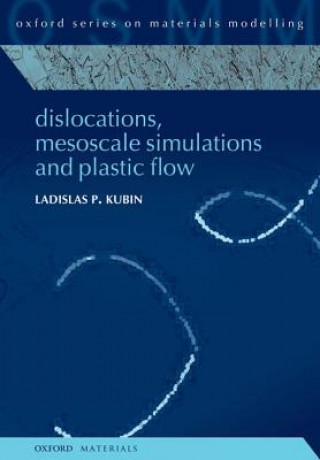
In the past twenty years, new experimental approaches, improved models and progress in simulation techniques brought new insights into long-standing issues concerning dislocation-based plasticity in crystalline materials. During this period, three-dimensional dislocation dynamics simulations appeared and reached maturity. Their objectives are to unravel the relation between individual and collective dislocation processes at the mesoscale, to establish connections with atom-scale studies of dislocation core properties and to bridge, in combination with modelling, the gap between defect properties and phenomenological continuum models for plastic flow. Dislocation dynamics simulations are becoming accessible to a wide range of users. This book presents to students and researchers in materials science and mechanical engineering a comprehensive coverage of the physical body of knowledge on which they are based. It includes classical studies, which are too often ignored, recent experimental and theoretical advances, as well as a discussion of selected applications on various topics.


Informatie over het boek
Engels
Categorieën

Geef dit boek vandaag nog cadeau
Dat gaat heel eenvoudig
1 Voeg het boek toe aan je winkelwagentje en selecteer Als cadeau bezorgen 2 Je krijgt van ons per omgaand een voucher 3 Het boek wordt bezorgd op het adres van de ontvangerDit vind je misschien ook interessant





 /
Gebonden (harde band)
29.65
€
/
Gebonden (harde band)
29.65
€
 /
Gebonden (harde band)
30.66
€
/
Gebonden (harde band)
30.66
€