
 Contact
 Hoe winkelen bij ons werkt
Bezorging
Winkelgids
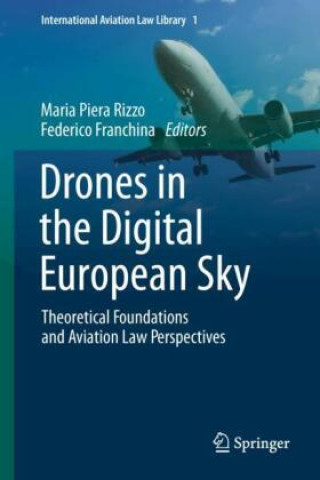
Drones in the Digital European Sky
Theoretical Foundations and Aviation Law Perspectives
 Engels
 125 b
125 b
 Nieuw
Nieuw
Tot 30 dagen retourrecht
Klanten kochten ook
























 /
/
 Gebonden (paperback)
 21.32
€
21.32
€



 /
Gebonden (paperback)
14.92
€
/
Gebonden (paperback)
14.92
€



 /
Gebonden (paperback)
94.54
€
/
Gebonden (paperback)
94.54
€

Originating from the PRIN 2022 research project ATM, Drones and D.A.N.T.E. (Digitalization, Artificial Intelligence and New Technologies for Environment), this open access book focuses on the fundamental epistemological transformation in aviation law sparked by the advent of Unmanned Aircraft Systems (UAS). The authors investigate how rapid technological advances and autonomous agents challenge the anthropocentric principles established by the 1944 Chicago Convention. Further, they delineate the progression of regulation from a weight-based philosophy to a more flexible risk-based and performance-based framework, driven by the heterogeneous nature of drone operations.
The book examines the crisis of categories, analyzing at which point flying objects are no longer classified as aircraft and how the product paradigm transition shifts emphasis from functionality to design, considering open category drones as consumer commodities. It also contrasts national frameworks such as Italy s assimilationist strategy and France s security-oriented model to underscore the tensions between national sovereignty and EU harmonization.
In turn, it describes how UAS have been integrated into Air Traffic Management through the Single European Sky (SES II+) initiative and the development of U-Space, a digital ecosystem designed to replace human-centric control with automated systems. To do so, the book examines e.g. Urban Air Mobility (UAM) infrastructure, such as vertiports, and the conflicts over regulatory authority between aviation authorities and municipal councils.
A substantial portion of the book addresses the decoupling of the Pilot-in-Command concept from the Black Box issue in connection with AI-based decision-making.
Given its scope, the book offers a valuable resource for legal practitioners, policymakers, and researchers interested in the stress test that autonomous agents represent for current legal frameworks. In addition, it advances aviation law scholarship by conceptualizing the Digital European Sky as a redefinition of the social contract for shared airspace, with the objective of promoting a secure and resilient future for civil aviation.


Informatie over het boek
Engels
Categorieën

Geef dit boek vandaag nog cadeau
Dat gaat heel eenvoudig
1 Voeg het boek toe aan je winkelwagentje en selecteer Als cadeau bezorgen 2 Je krijgt van ons per omgaand een voucher 3 Het boek wordt bezorgd op het adres van de ontvangerDit vind je misschien ook interessant




 /
Gebonden (harde band)
30.86
€
/
Gebonden (harde band)
30.86
€





















 /
Gebonden (paperback)
35.43
€
/
Gebonden (paperback)
35.43
€