
 Contact
 Hoe winkelen bij ons werkt

Bezorging
Winkelgids
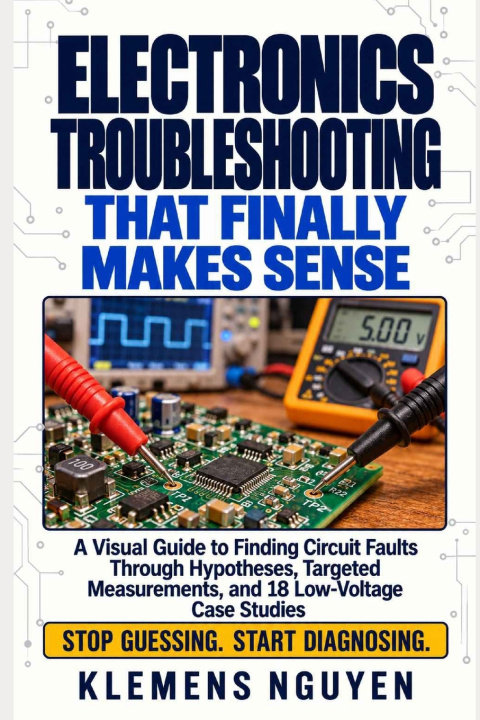
Electronics Troubleshooting That Finally Makes Sense
A Visual Guide to Finding Circuit Faults Through Hypotheses, Targeted Measurements, and 18 Low-Voltage Case Studies
 Engels
 45 b
 Wordt verwacht
 Nieuw
Tot 30 dagen retourrecht

You know the components. You can use a multimeter. But when a circuit fails, what should you measure next?
The supply reads 12 V, yet the board is dead. A sensor works until you connect the next stage. The output is wrong-even though the feedback voltages agree.
Electronics Troubleshooting That Finally Makes Sense helps you turn those confusing symptoms into a logical investigation.
Its distinctive focus is the decision behind each measurement: what you expect to find, which explanations the result can eliminate, and what to test next.
Through 18 illustrated low-voltage case studies, you'll practice a repeatable method:
Predict → Choose → Measure → Eliminate → Explain
Discover how to:
- Trace power faults: distinguish missing connections, voltage drops, excessive loading, and current limiting.
- Find signal problems: recognize when a meter reading hides pulses, brief disturbances, or oscillation.
- Interpret transistor and amplifier behavior: check drive levels, operating limits, and feedback paths before replacing components.
- Recognize misleading measurements: understand floating nodes, probe loading, and readings that confirm a symptom without identifying its cause.
- Verify your repair: establish why the fault occurred and confirm that the original operating conditions no longer trigger it.
Clear diagrams and concise explanations make this paperback a practical reference to keep beside your circuit. Diagnostic worksheets, expected-voltage and waveform tables, and challenges with explained answers help you apply the method to your own investigations.
Who is this book for?
Electronics students, hobbyists, makers, and technicians developing their diagnostic skills. If you understand basic components and measurements but struggle to move from "something is wrong" to a justified next test, this book is written for you.
The examples focus on low-voltage electronics and assume basic measurement knowledge. They do not cover mains-equipment servicing.
Make your next measurement count. Get your copy and learn to turn symptoms into evidence-and evidence into a diagnosis.


Informatie over het boek
Engels

Geef dit boek vandaag nog cadeau
Dat gaat heel eenvoudig
1 Voeg het boek toe aan je winkelwagentje en selecteer Als cadeau bezorgen 2 Je krijgt van ons per omgaand een voucher 3 Het boek wordt bezorgd op het adres van de ontvangerHoi! Ik ben Libroamiko, je boekadviseur.
Hoe kan ik je helpen?