
 Contact
 Hoe winkelen bij ons werkt
Bezorging
Winkelgids
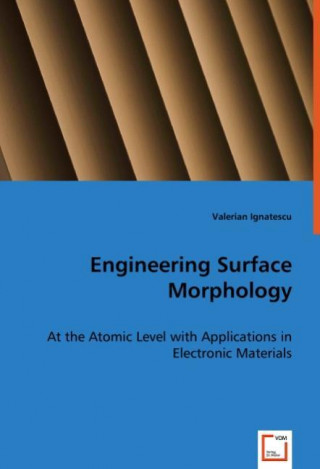
Engineering Surface Morphology
At the Atomic Level with Applications in Electronic Materials
 Engels
 152 b
152 b
Retourneren binnen 30 dagen
Klanten kochten ook




The silicon (111) and (001) surfaces have wide technological importance. Control of the morphologies of these surfaces at the atomic level is vital for such applications as layer-by-layer growth of epitaxial overlayers or assembly of nano-scale devices. By creating large areas with no or widely spaced atomic steps on patterned silicon surfaces by ultra-high vacuum (UHV) annealing, surface structures generated by surface premelting can be analyzed by simple quenching. The early roughness variation as a function of temperature and the morphologies that develop close to the boundaries of etched craters on Si(111) during UHV processing were also studied. Two applications using the substrates processed by UHV annealing were described. First, MOS capacitors were built on three types of Si(111) surfaces viz. atomically flat surfaces, stepped surfaces cleaned in UHV, and normal, RCA cleaned wafer surfaces. As expected, the smoother the Si substrate, the lower is the leakage current. In another application, Si(111) substrates with regular arrays of atomic steps were used to induce azimuthal alignment of crystals in thin polycrystalline pentacene films.


Informatie over het boek
Engels

Geef dit boek vandaag nog cadeau
Dat gaat heel eenvoudig
1 Voeg het boek toe aan je winkelwagentje en selecteer Als cadeau bezorgen 2 Je krijgt van ons per omgaand een voucher 3 Het boek wordt bezorgd op het adres van de ontvangerDit vind je misschien ook interessant


 /
/
 Gebonden (paperback)
 14.88
€
14.88
€
Hoi! Ik ben Libroamiko, je boekadviseur.
Hoe kan ik je helpen?