
 Contact
 Hoe winkelen bij ons werkt
Bezorging
Winkelgids
 Engels
 38 b
38 b
 Nieuw
Nieuw
Tot 30 dagen retourrecht

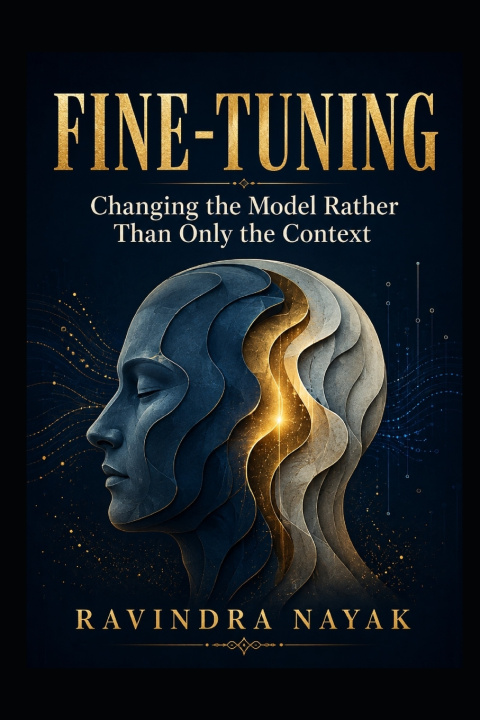
Better prompts can take you surprisingly far. Better context can solve even more. But what happens when the same behaviour problem keeps returning-when the model has the information it needs, the instructions are reasonable, and the output still does not reliably behave the way the task demands?
That is the question at the heart of Fine-Tuning: Changing the Model Rather Than Only the Context.
Written for non-technical readers, this book makes fine-tuning understandable from first principles before asking you to remember machine-learning vocabulary. It begins with the most important decision of all: should the model change at all? From there, the reader builds a complete mental model of how additional training changes learned tendencies, why examples act like a curriculum, how loss and gradients guide adjustment, and why more training is not automatically better training.
The journey then moves into the practical choices that shape a real adaptation project: full fine-tuning, frozen parameters, PEFT, adapters, LoRA, rank, quantization, and resource-aware methods. The mathematics is introduced only when it earns its place, using small examples and ordinary language so that ideas such as learning rate, batches, checkpoints, overfitting, validation, and low-rank updates become understandable rather than intimidating.
Just as importantly, the book treats data as teaching design. You will learn to reason about training examples, cleaning, deduplication, leakage, coverage, hard cases, synthetic examples, preference judgments, provenance, privacy, and holdout sets. You will also see why a fine-tuned model must prove itself beyond one headline score through regression tests, robustness checks, calibration, safety evidence, staged deployment, and rollback planning.
Later sections explain preference learning and alignment from the ground up, including reward signals, RLHF, direct preference methods, drift control, multi-objective trade-offs, and the danger of optimizing an incomplete proxy. The lifecycle section then follows the tuned model into production: versioning, monitoring, drift, feedback loops, retraining triggers, economics, ownership, replacement, and retirement.
The closing Value Edition turns the entire book into active practice through reconstruction drills, mini cases, decision cards, mathematics-without-fear exercises, a twelve-step fine-tuning playbook, and a thirty-day learning plan.
This is not a code recipe or a promise that every problem needs training. It is a practical guide to thinking clearly about when fine-tuning belongs, what it changes, how to teach responsibly, how to evaluate honestly, and how to keep the result useful and reversible in the real world.


Informatie over het boek
Engels

Geef dit boek vandaag nog cadeau
Dat gaat heel eenvoudig
1 Voeg het boek toe aan je winkelwagentje en selecteer Als cadeau bezorgen 2 Je krijgt van ons per omgaand een voucher 3 Het boek wordt bezorgd op het adres van de ontvangerHoi! Ik ben Libroamiko, je boekadviseur.
Hoe kan ik je helpen?