
 Contact
 Hoe winkelen bij ons werkt
Bezorging
Winkelgids
 Engels
 249 b
249 b
Tot 30 dagen retourrecht
Klanten kochten ook

















 /
/
 Paperback
 37.06
€
37.06
€

 /
Paperback
49.61
€
/
Paperback
49.61
€
 /
Paperback
23.90
€
/
Paperback
23.90
€


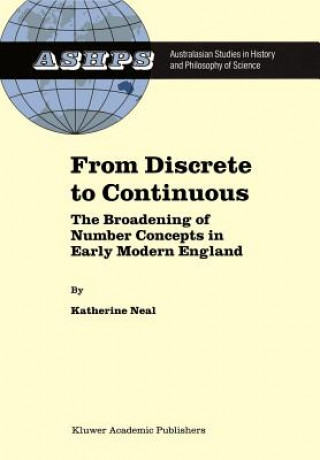
In the early modern period, a crucial transformation occurred in the classical conception of number and magnitude. Traditionally, numbers were merely collections of discrete units that measured some multiple. Magnitude, on the other hand, was usually described as being continuous, or being divisible into parts that are infinitely divisible. This traditional idea of discrete number versus continuous magnitude was challenged in the early modern period in several ways.§This detailed study explores how the development of algebraic symbolism, logarithms, and the growing practical demands for an expanded number concept all contributed to a broadening of the number concept in early modern England. An interest in solving practical problems was not, in itself, enough to cause a generalisation of the number concept. It was the combined impact of novel practical applications together with the concomitant development of such mathematical advances as algebraic notation and logarithms that produced a broadened number concept.


Informatie over het boek
Engels

Geef dit boek vandaag nog cadeau
Dat gaat heel eenvoudig
1 Voeg het boek toe aan je winkelwagentje en selecteer Als cadeau bezorgen 2 Je krijgt van ons per omgaand een voucher 3 Het boek wordt bezorgd op het adres van de ontvangerDit vind je misschien ook interessant



















Hoi! Ik ben Libroamiko, je boekadviseur.
Hoe kan ik je helpen?