
 Contact
 Hoe winkelen bij ons werkt
Bezorging
Winkelgids
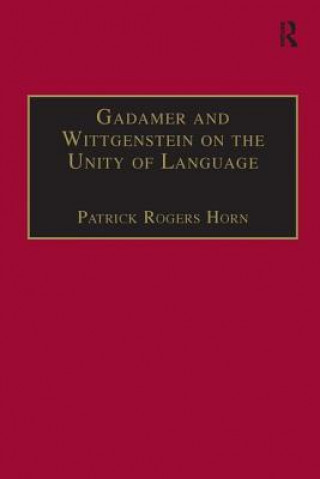
Gadamer and Wittgenstein on the Unity of Language
 Engels
 591 b
591 b
Tot 30 dagen retourrecht
Klanten kochten ook

 /
/
 Gebonden (paperback)
 8.84
€
8.84
€







In this innovative comparison of Gadamer and Wittgenstein, the author explores their common concern with the relation of language to reality. Patrick Horn's starting point is the widely accepted view that both philosophers rejected a certain metaphysical account of that relation in which reality determines the nature of language. Horn proceeds to argue that Gadamer never completely escaped metaphysical assumptions in his search for the unity of language. In this respect, argues Horn, Gadamer's work is nearer to the earlier rather than to the later Wittgenstein. The final chapter of the book highlights the work of Wittgenstein's pupil Rush Rhees, who shows that Wittgenstein's own later emphasis on language games, while doing justice to the variety of language, does less than justice to the dialogical relation between speakers of a language, wherein the unity of language resides. Contrasting Rhees's account of the unity of language with those given by Gadamer and the early Wittgenstein brings out the importance of understanding reality in terms of the life that people share rather than in terms of what philosophers say about reality.


Informatie over het boek
Engels

Geef dit boek vandaag nog cadeau
Dat gaat heel eenvoudig
1 Voeg het boek toe aan je winkelwagentje en selecteer Als cadeau bezorgen 2 Je krijgt van ons per omgaand een voucher 3 Het boek wordt bezorgd op het adres van de ontvangerDit vind je misschien ook interessant








 /
Gebonden (paperback)
10.25
€
/
Gebonden (paperback)
10.25
€

 /
Gebonden (harde band)
34.28
€
/
Gebonden (harde band)
34.28
€
 /
Gebonden (paperback)
9.14
€
/
Gebonden (paperback)
9.14
€

 /
Gebonden (paperback)
24.93
€
/
Gebonden (paperback)
24.93
€
 /
Gebonden (paperback)
19.20
€
/
Gebonden (paperback)
19.20
€

 /
Gebonden (paperback)
19.20
€
/
Gebonden (paperback)
19.20
€






Hoi! Ik ben Libroamiko, je boekadviseur.
Hoe kan ik je helpen?