
 Contact
 Hoe winkelen bij ons werkt

Bezorging
Winkelgids
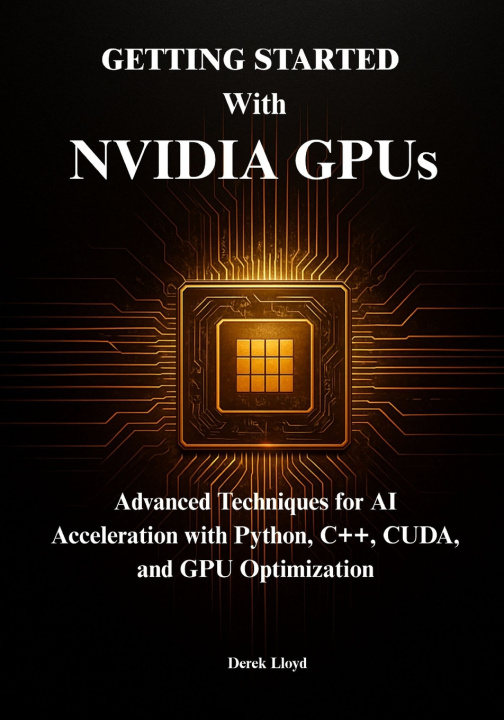
Getting started with NVIDIA GPUs
Advanced Techniques for AI Acceleration with Python, C++, CUDA, and GPU Optimization
 Engels
 86 b
 Wordt verwacht
 Nieuw
Tot 30 dagen retourrecht

Your NVIDIA GPU is powerful. Are you getting everything out of it?
Whether your model trains too slowly, your language model won't fit in VRAM, or your AI service isn't ready for production, this book shows you how to turn GPU hardware into measurable, repeatable performance. Getting Started with NVIDIA GPUs, Second Edition, teaches you to build, profile, optimize, and deploy GPU-accelerated AI applications using Python, C++, CUDA, PyTorch, TensorRT, and Triton Inference Server. You will learn to choose the right GPU for deep learning, LLM inference, computer vision, or edge AI, create reproducible CUDA and Docker environments, write advanced CUDA C++ kernels, find bottlenecks with Nsight Systems and Nsight Compute, and ship optimized models as scalable inference services.
NVIDIA GPUs drive modern deep learning, generative AI, and real-time computer vision. CUDA gives developers direct control over parallel computing, while PyTorch, ONNX, TensorRT, and Triton turn that power into fast, production-ready applications across consumer RTX cards, professional workstations, data-center accelerators, and Jetson edge devices.
This second edition expands the first edition with a more engineering-focused, hands-on approach. It starts with GPU architecture, hardware planning, driver compatibility, containers, and CUDA memory management, then moves into profiling, benchmarking, and kernel optimization. You then apply those foundations to PyTorch training with mixed precision, YOLO object detection, LLM quantization and KV cache analysis, text-to-image diffusion, and LoRA fine-tuning, with working code and measured results throughout.
The final chapters take you from experiment to production. You will export models to ONNX, build TensorRT engines, compare framework and optimized runtime performance, and deploy through Triton with HTTP and gRPC APIs, dynamic batching, monitoring, and load testing.
Inside, you will gain practical guidance for selecting GPUs by VRAM, memory bandwidth, and power limits, along with reliable setups that eliminate driver and library headaches. You will learn to write and test CUDA kernels with streams, shared memory, and CUDA Graphs, speed up training and reduce memory use with data-loading and mixed-precision techniques, run larger language models on limited hardware, and prove every improvement with accuracy, latency, and throughput benchmarks. You will also build real projects, including a webcam detection app, a local image generation workflow, and a load-tested inference service.
This book is for Python developers, machine learning engineers, AI practitioners, and software engineers who are ready to move beyond the basics of GPU computing. Familiarity with Python and the command line will help you get the most from every chapter.
Stop guessing and start measuring.
Grab your copy of Getting Started with NVIDIA GPUs, Second Edition, today and build faster, leaner, production-ready AI.


Informatie over het boek
Engels

Geef dit boek vandaag nog cadeau
Dat gaat heel eenvoudig
1 Voeg het boek toe aan je winkelwagentje en selecteer Als cadeau bezorgen 2 Je krijgt van ons per omgaand een voucher 3 Het boek wordt bezorgd op het adres van de ontvangerHoi! Ik ben Libroamiko, je boekadviseur.
Hoe kan ik je helpen?