
 Contact
 Hoe winkelen bij ons werkt
Bezorging
Winkelgids
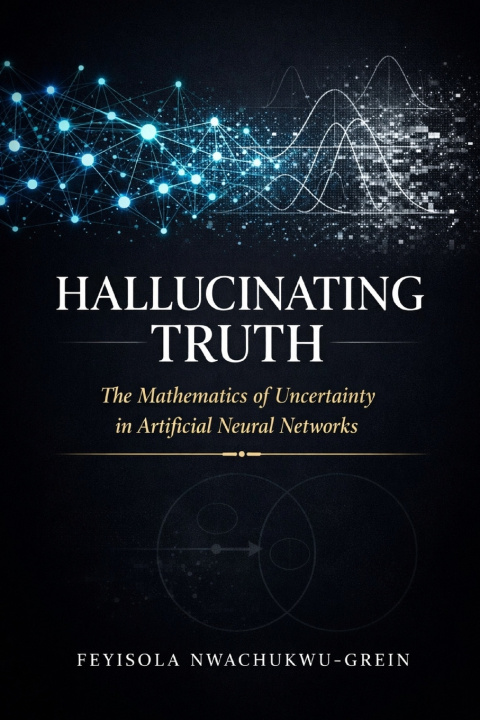
Hallucinating Truth
The Mathematics of Uncertainty in Artificial Neural Networks
 Engels
 53 b
53 b
 Wordt verwacht
 Nieuw
Nieuw
Tot 30 dagen retourrecht

Your AI assistant just gave you a confident, detailed, completely fabricated answer. You believed it. This is not a glitch. It is mathematics.
Hallucinating Truth is the book that finally tells you why the most powerful AI systems ever built lie with such extraordinary composure, and what the equations governing that behavior actually say. Feyisola Nwachukwu-Grein cuts through the noise of AI hype and AI panic alike to deliver something rarer: a rigorous, readable account of the precise mathematical mechanisms that make neural networks confidently wrong.
This is a book about probability distributions that forget they are probability distributions. About loss landscapes that train models to perform certainty rather than earn it. About Bayes' theorem, which describes exactly how a rational mind should hold uncertainty, and about the vast gap between that ideal and what your AI actually does when it tells you a court case happened that never did.
You will understand, in precise terms, why hallucination is not a content moderation problem or a safety fine-tuning problem. It is a calibration problem. A model that assigns the same confident tone to things it knows and things it has interpolated from statistical shadows is not malfunctioning. It is doing exactly what it was trained to do. The training objective never asked for honesty about uncertainty. It asked for low loss. It got low loss.
Chapter by chapter, this book builds the complete picture: the architecture of illusion inside transformer networks, the Bayesian framework that reveals what a truly honest AI would look like, information theory's hard limits on what any finite dataset can teach, and the full arsenal of modern mitigations from conformal prediction guarantees to retrieval-augmented generation to constitutional training methods. Real case studies from medicine, law, science, and finance show where confident errors have already caused genuine harm.
This is not a book that asks you to fear AI or to trust it blindly. It asks something harder and more interesting: to understand it mathematically, so that when you build with it, deploy it, regulate it, or simply use it, you do so with clear eyes about what it can and cannot know. The era of deploying AI systems without understanding their uncertainty is ending. This book is where the understanding begins.


Informatie over het boek
Engels

Geef dit boek vandaag nog cadeau
Dat gaat heel eenvoudig
1 Voeg het boek toe aan je winkelwagentje en selecteer Als cadeau bezorgen 2 Je krijgt van ons per omgaand een voucher 3 Het boek wordt bezorgd op het adres van de ontvangerHoi! Ik ben Libroamiko, je boekadviseur.
Hoe kan ik je helpen?