
 Contact
 Hoe winkelen bij ons werkt
Bezorging
Winkelgids
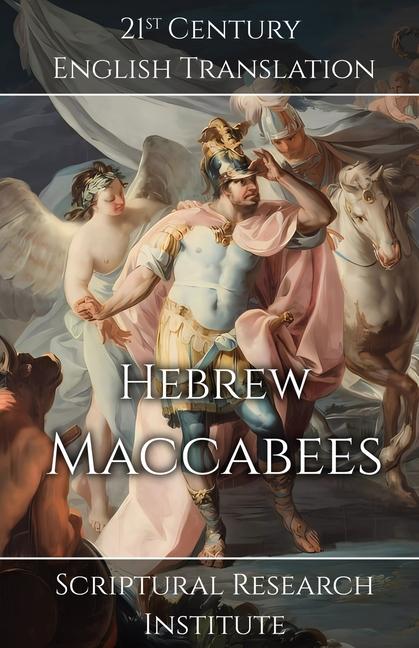
Hebrew Maccabees
 Engels
 38 b
38 b
Tot 30 dagen retourrecht
Klanten kochten ook




Hebrew Maccabees is one of the stranger Hebrew books to have survived to the present and is either a relic the oldest surviving book about Judas the Hammer, or a remarkably heretical medieval forgery. There is no academic consensus on what it is, and few scholars have bothered to comment on it. The book deals with the life of Judas 'the Maccabee,' which is of little interest to Christians. His life is of interest to Jews, however, almost all books dealing with the Maccabean Revolt are rejected as scripture in Rabbinical Judaism. Jews generally treat the Septuagint's 1st and 2nd Maccabees, and Josephus' Antiquities of the Judeans as historical texts of debatable accuracy, while using the Megillat Taanit and Megillat Antiochus as sources on how Hanukkah should be practiced. Hanukkah, also called the Festival of Lights, is a holiday based on the rededication of the temple in Jerusalem that happened when Judas occupied Jerusalem. The festival continues, but all records of what happened are lost or ignored.
The Megillat Taanit dates to the 1st century AD, and Megillat Antiochus dates to the 2nd century AD, and neither is considered a historically reliable source by academics. This suggests that what actually happened in the time of Judas was actively suppressed during the Hasmonean and Herodian dynasties, likely because Judas was later viewed as a heretic. In most of the books featuring Judas, he reports seeing angelic horsemen that no one else could see. These horsemen are clearly part of Judas' story, however, if they were, in fact, angels riding horses, then Judas would be a prophet. Yet, he is not accepted as a prophet in Judaism or Christianity. The idea of angels riding horses is itself unheard of in Israelite and Judahite texts, other than in texts related to Judas, which suggests he may have actually been following a different religion. During the era of the Maccabean Revolt, the high priest in Jerusalem was not a Judahite, but a Phrygian named Philip. The Phrygians worshiped Sabazdiôs, the great horseman of the sky, who was represented by a hand. The Greeks interpreted the Phrygian Sabazdiôs and Judahite Sabaoth as two forms of Dionysus. In 2nd Maccabees, Dionysus is used as the name of the god worshiped in the temple in Jerusalem under Greek rule. Sabaoth was recorded by the Greeks of the Hellenistic era as the name of the Judahite god, based on the Aramaic ṣbảủt, meaning 'desires.' However, this word took on a very different meaning as Classical Hebrew formed during the Maccabean Revolt, becoming a word meaning 'armies' or 'battles.'
The duel meanings of 'ṣbảwt' in Semitic languages go back to very ancient times, where the oldest recorded form was the Akkadian ṣābum, meaning 'soldier.' Over thousands of years, the name transitioned to 'server' and finally 'desires' in Aramaic and 'abundance' in Arabic. When the Hasmonean dynasty decided to 'restore' the Hebrew language, many ancient words and meanings were introduced to the Judahite dialect of Canaanite, resulting in the new Hebrew language having many archaic terms, including ṣbảwt. The name Sabaoth is used in the Septuagint, generally where the Masoretic texts used the word 'armies,' which has resulted in many modern academics simply accepting this as a mistranslation, however, in Hebrew Maccabees, Judas is repeatedly referred to as the 'Anointed of Sabaoth,' confirming that the author viewed Sabaoth as a god. While it is natural to assume that the Maccabean Revolt was about getting rid of the worship of Sabaoth, this book contradicts that, and reports that Judas was a Sabaoth worshiper. Moreover, there is some evidence of the continuation of Sabaoth worship under the rule of the Hasmoneans in the writing of Josephus, and also the Babylonian Talmu


Informatie over het boek
Engels

Geef dit boek vandaag nog cadeau
Dat gaat heel eenvoudig
1 Voeg het boek toe aan je winkelwagentje en selecteer Als cadeau bezorgen 2 Je krijgt van ons per omgaand een voucher 3 Het boek wordt bezorgd op het adres van de ontvangerDit vind je misschien ook interessant


 /
/
 Gebonden (harde band)
 162.45
€
162.45
€
Hoi! Ik ben Libroamiko, je boekadviseur.
Hoe kan ik je helpen?