Contact
 Hoe winkelen bij ons werkt
Bezorging
Winkelgids
 Engels
 290 b
290 b
Tot 30 dagen retourrecht
Klanten kochten ook

 /
/
 Gebonden (paperback)
 39.31
€
39.31
€














 /
Gebonden (harde band)
26.04
€
/
Gebonden (harde band)
26.04
€



 /
Gebonden (paperback)
8.60
€
/
Gebonden (paperback)
8.60
€







 /
Gebonden (paperback)
44.58
€
/
Gebonden (paperback)
44.58
€

 /
Gebonden (paperback)
57.96
€
/
Gebonden (paperback)
57.96
€
 /
Gebonden (paperback)
42.86
€
/
Gebonden (paperback)
42.86
€

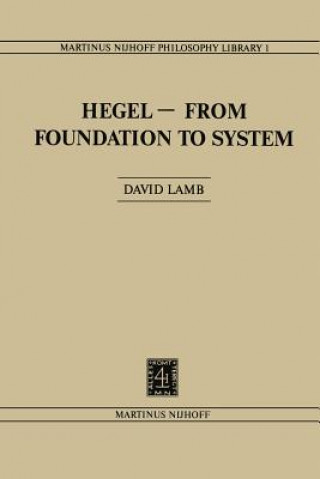
One of the guiding thoughts throughout this work is that G. W. F. Hegel is the philosopher of the modern age, that subsequent phil osophers, whether or not they have read his works, must take their stand in relation to Hegel. My purpose is not only to present Hegel, but to show that his influence has been felt for some time, even though his presence has not been explicitly acknowledged. In spite of a recent revival in Heglian scholarship, the history of philosophy in the English-speaking world is generally obscured by a period of darkness between Kant and the early inquiries of Russell and Frege. A place is assigned to Mill and Bentham, but even today very few Anglo-Saxon philosophers would be prepared to recognise Marx as a philosopher, although it is widely held that Marx was in some way influenced by Hegel, which is probably a good reason for not paying too much attention to the latter. At best, an understand ing of Hegel is relevant to an understanding of Marx, but it is not considered that Hegel made a significant contribution to the main stream of Western philosophy from Descartes onwards, and it is assumed that he is of little relevance to the 'linguistic revolution' pioneered by Wittgenstein, Ryle, and Austin.


Informatie over het boek

Geef dit boek vandaag nog cadeau
Dat gaat heel eenvoudig
1 Voeg het boek toe aan je winkelwagentje en selecteer Als cadeau bezorgen 2 Je krijgt van ons per omgaand een voucher 3 Het boek wordt bezorgd op het adres van de ontvangerDit vind je misschien ook interessant


 /
Gebonden (paperback)
54.01
€
/
Gebonden (paperback)
54.01
€




 /
Gebonden (paperback)
28.87
€
/
Gebonden (paperback)
28.87
€




 /
Gebonden (paperback)
32.62
€
/
Gebonden (paperback)
32.62
€



 /
Gebonden (paperback)
25.22
€
/
Gebonden (paperback)
25.22
€