Gratis verzending vanaf 59,99 euro.

Word lid van een gemeenschap van boekenliefhebbers van over de hele wereld en krijg een heleboel voordelen.
Gratis account aanmaken
Gratis bezorging met Zásilkovna boven 59.99 €
DPD koerier 5.49 €
DHL koeriersdienst 5.49 €
GLS koerier 4.99 €
DPD-punt 3.99 €
 Contact
 Hoe winkelen bij ons werkt
Help
Bezorging
DPD koerier 5.49 €
DHL koeriersdienst 5.49 €
GLS koerier 4.99 €
DPD-punt 3.99 €
Gratis bezorging met Zásilkovna boven 59.99 €
Winkelgids
Mijn account
▸
Leeg :-(
0
Gratis verzending vanaf 59,99 euro.
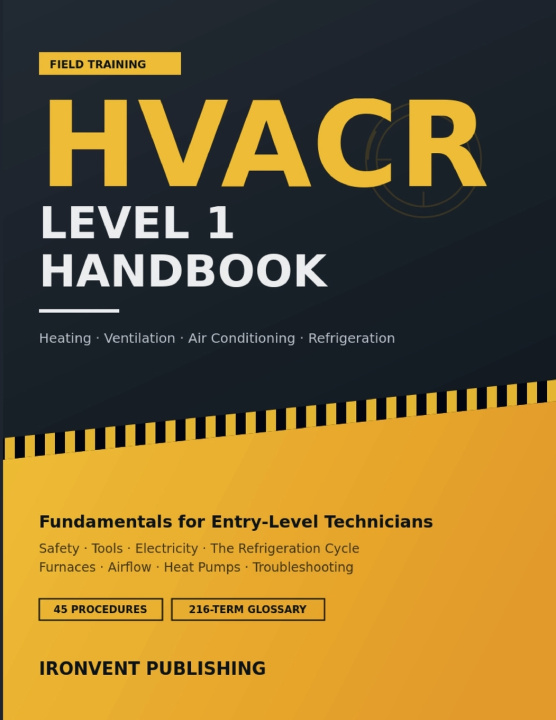
HVACR Level 1 Handbook
Fundamentals of Heating, Ventilation, Air Conditioning, and Refrigeration for Entry-Level Technicians
Taal
 Engels
Engels
Boek
Gebonden (paperback)
Low airflow and low refrigerant charge look identical on a set of gauges.Add refrigerant to the wron...
Volledige beschrijving
Libristo-code: 53530284
?
 247 b
247 b
 Wordt verwacht
 Nieuw
Nieuw
247 b
Wordt verwacht
Nieuw
101.89
€
Naar verwachting op voorraad
Op voorraad op 19. 08. 2026
Tot 30 dagen retourrecht

Low airflow and low refrigerant charge look identical on a set of gauges.
Add refrigerant to the wrong one, and you have just created a second fault on top of the first. Knowing which is which - before you touch a valve - is what separates a technician from a parts changer.
That is what this handbook teaches.
HVACR LEVEL 1 HANDBOOK is independently written for the person with no field experience: the apprentice, the trade-school student, the career changer, the new hire someone has to bring up to speed. It works from principle to practice - what the physics is doing, what the component does about it, how you measure it, and what a failure looks like on your meter.
It starts where you actually start: with the six ways this trade injures people, and how to lock out a circuit and prove it dead before your hand goes near a terminal. Then it builds - tools and measurement, heat and pressure, electricity, the refrigeration cycle, refrigerants and recovery, brazing and leak detection, gas and oil furnaces, boilers and electric heat, airflow, ductwork, air conditioning, and heat pumps. It closes with a systematic troubleshooting method you can run on a machine you have never seen before.
WHAT YOU GET
- 16 chapters covering the full entry-level scope, from safety through systematic diagnosis
- More than 45 numbered field procedures - each one opening with the tools you need, so nothing is a paragraph you have to decode on a ladder
- 50 worked examples laid out as Problem, Given, Solution, Answer - with every unit carried through the arithmetic, because a Btu where a Btu per hour belongs means the setup was wrong
- 129 reference and troubleshooting tables - refrigerant properties, conductor ampacity, fault signatures, and symptom-to-cause charts you will actually use on a call
- 160 review questions with full answers, mixing recall, calculation, and short-answer diagnosis
- A 216-term glossary, plus conversion and formula quick reference, pressure-temperature explanation, and standard electrical and piping symbol keys
- EPA Section 608 preparation - certification types, core prohibitions, recovery, evacuation, and charging
- 47 safety callouts placed at the step that creates the hazard, not collected at the back where they are easy to skip
WHY THIS ONE IS DIFFERENT
Most manuals hand you numbers to memorize. This one refuses to.
Where a value belongs to one specific machine - charge weight, manifold pressure, wire and breaker sizing, clearances, torque, vent length, superheat and subcooling targets - this book does not invent a figure for you to carry into the field. It teaches you where that number lives: the data plate, the rating plate, the charging chart, the wiring diagram on the panel cover, and the code adopted where you work.
Building that habit is the point. It is also the difference between a diagnosis that holds and a callback.
For apprentices, trade-school students, career changers, EPA 608 and NATE candidates, and anyone responsible for training a new hire.
Order Your Copy. Stop guessing. Start measuring.
Actrice
&
Polyglot
EWA KASP
voor
Video afspelen


Libristo heeft de grootste selectie boeken in vreemde talen. Daarom koop ik mijn boeken hier.
Informatie over het boek
Volledige naam
HVACR Level 1 Handbook
Auteur
Ironvent Publishing
Taal
Engels
Engels
Bindwijze
Boek - Gebonden (paperback)
Datum van uitgifte
2026
Aantal pagina's
380
EAN
9798192378076
Libristo-code
53530284
Uitgeverij
Independently published
Gewicht
880
Afmetingen
216 x 280 x 20

Geef dit boek vandaag nog cadeau
Dat gaat heel eenvoudig
1 Voeg het boek toe aan je winkelwagentje en selecteer Als cadeau bezorgen 2 Je krijgt van ons per omgaand een voucher 3 Het boek wordt bezorgd op het adres van de ontvanger
Boekadviseur Libroamiko
Door deze chat te gebruiken, communiceer je met generatieve kunstmatige intelligentie. Door het te gebruiken, ga je ook akkoord met de verwerking van persoonsgegevens.
Hoi! Ik ben Libroamiko, je boekadviseur.
Hoe kan ik je helpen?
Hoi, ik ben Libroamiko, kan ik helpen?