
 Contact
 Hoe winkelen bij ons werkt
Bezorging
Winkelgids
I lean on the emptyness
 Engels
 40 b
40 b
Tot 30 dagen retourrecht
Klanten kochten ook

 /
/
 Gebonden (paperback)
 38.33
€
38.33
€


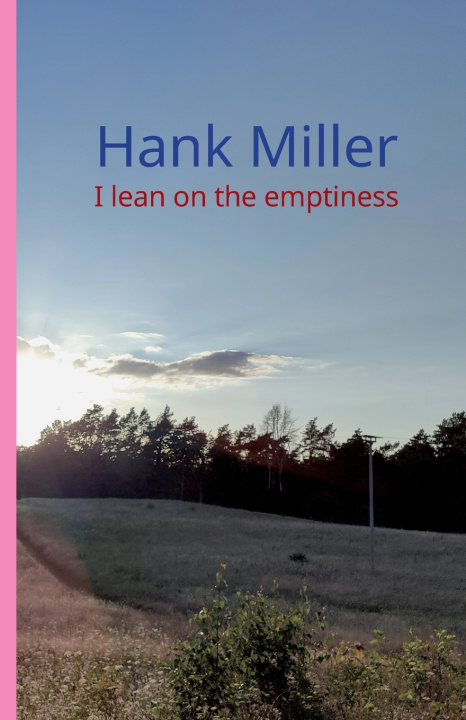
Hank Miller's second book, I lean on the emptyness, emerges as a literary masterpiece that both disturbs and captivates the reader. In many ways, it extends the themes and visions of his debut, Timeless Spaces, but here the author decisively moves away from the fragile beauty of memory and embarks on a more radical, painful journey into the abyss of language. Where the first book was a near-meditative exploration of space and time, the second transforms into a nearly physical experience of inner decay. In these fragments-more than mere words-lies the disintegration of a self caught between life and death, between consciousness and madness.
"Words without a soul spill out of me," writes the narrator at the beginning of the book, and already this first sentence hints that no simple narrative is to follow. Miller opens his work with a diagnosis of his own language. It is empty, it misses its mark, it does not stay with itself. Yet, paradoxically, it is the only expression of what remains: a self that, in its final convulsions, dissects the world into fragments. The metaphors he chooses are brutal and intense: The brain is "cooked in a pot, seasoned with salt from the Dead Sea." The image of cooking might initially appear as a depiction of control-but the sharpness of the "salt from the Dead Sea" does not fail to make its point. It refers to the inescapable depth of pain, to the understanding that this preparation is neither curative nor healing.
The physical experience Miller describes here is not mere metaphor. It is writing in extremis: The brain is "opened," the narrator watches the "fluid" spill from it, and tastes "heavily salted sardines and dozens of capers on his tongue." It is the unfolding of a monstrous body that surrenders itself to its own decomposition and exposure. In an almost surreal twist, the narrator lifts his own brain from his skull and places it in the pot to "slowly cook." Here, two levels merge: the language of the narrative body and the language of the book itself, which dissolves in the act of "cooking."
The narrator is in search of a language to serve as a means of survival, yet this search proves futile. "Where are my words?" he asks. The meaning the text once conveyed seems to have shattered in the windy space of confusion. A key moment in the book is the recurring question about the "words of the songs," about the "flickering lights on the stage of memory." This repetition signals a problem that underlies the entire work: the existential void into which the narrator sinks at every moment. Words no longer provide comfort; they are merely a reminder of what once was. But in the void, nothing can be found-only the "noise" that obscures the silence and brings forth the realization of the futility outside.
In one of the most poignant passages, the image of the void transforms into an almost poetic picture of decay and finitude. The candles flicker, the birds fall silent, the "writing reveals nothing to me." This state of disorientation, accompanied not only by physical pain but also by mental fragmentation, describes an existential crisis that goes far beyond what words can capture. Here, the word remains nothing more than an empty vessel-a symbol for the void the narrator feels deep within.
With I lean on the emptyness, Hank Miller delivers a gripping, almost agonizing exploration of the fragmentation of human existence. There is no simple redemption here, only confrontation with the inner abysses. With this work, Miller takes on a timeless theme in literature: the desire to grasp the unspeakable, and the realization that language often provides only another expression of one's own emptiness.
It is a book that does not leave the reader untouched, one that raises questions-about our perception of reality, the state of thinking, and the fragility of the human psyche. And perhaps this is the only comfort: In the void itself lies a form of freedom.


Informatie over het boek
Engels
Categorieën

Geef dit boek vandaag nog cadeau
Dat gaat heel eenvoudig
1 Voeg het boek toe aan je winkelwagentje en selecteer Als cadeau bezorgen 2 Je krijgt van ons per omgaand een voucher 3 Het boek wordt bezorgd op het adres van de ontvangerDit vind je misschien ook interessant

 /
Gebonden (paperback)
25.58
€
/
Gebonden (paperback)
25.58
€
Hoi! Ik ben Libroamiko, je boekadviseur.
Hoe kan ik je helpen?