
 Contact
 Hoe winkelen bij ons werkt
Bezorging
Winkelgids
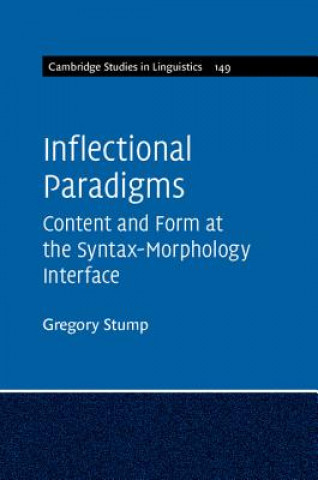
Inflectional Paradigms
 Engels
 101 b
101 b
Retourneren binnen 30 dagen
Klanten kochten ook











 /
/
 Gebonden (paperback)
 6.07
€
6.07
€

 /
Gebonden (paperback)
11.23
€
/
Gebonden (paperback)
11.23
€


Sometimes dismissed as linguistically epiphenomenal, inflectional paradigms are, in reality, the interface of a language's morphology with its syntax and semantics. Drawing on abundant evidence from a wide range of languages (French, Hua, Hungarian, Kashmiri, Latin, Nepali, Noon, Old Norse, Sanskrit, Turkish, Twi and others), Stump examines a variety of mismatches between words' content and form, including morphomic patterns, defectiveness, overabundance, syncretism, suppletion, deponency and polyfunctionality. He demonstrates that such mismatches motivate a new grammatical architecture in which two kinds of paradigms are distinguished: content paradigms, which determine word forms' syntactic distribution and semantic interpretation, and form paradigms, which determine their inflectional realization. In this framework, the often nontrivial linkage between a lexeme's content paradigm and its stems' form paradigm is the nexus at which incongruities of content and form are resolved. Stump presents clear and precise analyses of a range of morphological phenomena in support of this theoretical innovation.


Informatie over het boek
Engels
Categorieën

Geef dit boek vandaag nog cadeau
Dat gaat heel eenvoudig
1 Voeg het boek toe aan je winkelwagentje en selecteer Als cadeau bezorgen 2 Je krijgt van ons per omgaand een voucher 3 Het boek wordt bezorgd op het adres van de ontvangerDit vind je misschien ook interessant




 /
Gebonden (paperback)
24.80
€
/
Gebonden (paperback)
24.80
€

 /
Gebonden (harde band)
18.62
€
/
Gebonden (harde band)
18.62
€



 /
Gebonden (harde band)
33.30
€
/
Gebonden (harde band)
33.30
€











Hoi! Ik ben Libroamiko, je boekadviseur.
Hoe kan ik je helpen?