
 Contact
 Hoe winkelen bij ons werkt

Bezorging
Winkelgids
 Engels
 80 b
 Nieuw
 Wordt voor Kerst bezorgd ▾
In extern magazijn
Wordt binnen 14-21 dagen verzonden
Tot 30 dagen retourrecht

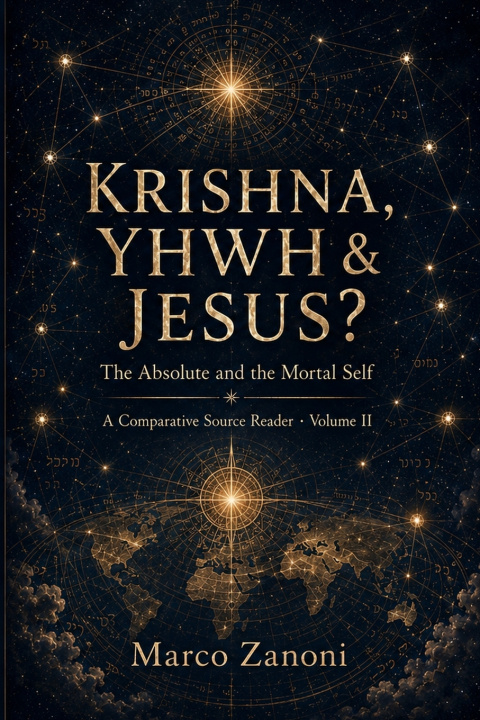
What happens when a verse from the Bhagavad Gītā is dropped into the Bible's vast cross-reference network-and allowed to travel through centuries of scripture?
Krishna, YHWH & Jesus? turns comparative religion into something closer to a map of ideas across time.
Beginning with twenty-four major declarations from the Bhagavad Gītā, the book traces their strongest connections outward: first through ancient Indian texts such as the Upaniṣads, then into Hebrew scriptures reaching deep into the first millennium BCE, through Psalms, prophets and biblical theophanies, onward to the teachings attributed to Jesus, later New Testament writings, Revelation and the Gospel of Thomas.
The result is not a collection of convenient quotations.
It is a scriptural constellation.
A single Gītā statement such as "I am Time" can open into a network involving divine judgment, human instrumentality, Isaiah, apocalyptic imagery and older Indian ideas of Time and ultimate reality.
Krishna's declaration that all beings are in him leads into ancient Indian teachings about the Self and inner controller, biblical traditions of divine presence, Johannine indwelling-and crucial passages where the resemblance breaks.
And when Krishna finally tells Arjuna to "take refuge in me alone," one Sanskrit verse unfolds into centuries of biblical language about refuge, trust, deliverance, exclusive loyalty, transgression and reassurance.
But this book was designed to let attractive parallels fail.
More than 2,100 deeper biblical cross-reference routes were examined. Only 123 were retained. 1,914 were rejected. Many of the surviving connections remain in the book precisely because they reveal a difference rather than an identity.
So:
ātman is not simply the biblical soul.
Rebirth is not resurrection.
avatāra is not automatically incarnation.
pāpa is not automatically biblical sin.
mokṣa is not simply Christian salvation.
And when Krishna says "I am Time," that is not the same statement as the biblical God ruling over time.
Across twenty-four visual constellation maps, verses become nodes and relationships become lines: Gītā, Upaniṣads, Hebrew Bible, canonical Gospel traditions, later New Testament writings, Revelation and Thomas-connected according to lexical, conceptual, structural, functional and contrastive evidence.
The Bible itself becomes something like a neuronal network of scripture, with one passage opening into another across centuries of composition.
Yet the question remains:
Are these shared ideas?
Parallel solutions to the same human problems?
Independent theological developments?
Or evidence that ancient religious worlds once touched?
Three research passes, Sanskrit and biblical-language controls, classical commentaries, manuscript evidence and thousands of candidate links lead to a conclusion more interesting than "they are all the same."
Some parallels survive. Some become stronger. Some collapse completely. And sometimes the difference is the discovery.
Krishna, YHWH & Jesus? - The Absolute and the Mortal Self is a visual comparative source reader for anyone fascinated by the Bible, the Bhagavad Gītā, ancient theology, lost connections, comparative religion-and the enormous networks hidden behind a single verse.


Informatie over het boek
Engels
Categorieën

Geef dit boek vandaag nog cadeau
Dat gaat heel eenvoudig
1 Voeg het boek toe aan je winkelwagentje en selecteer Als cadeau bezorgen 2 Je krijgt van ons per omgaand een voucher 3 Het boek wordt bezorgd op het adres van de ontvangerHoi! Ik ben Libroamiko, je boekadviseur.
Hoe kan ik je helpen?