
 Contact
 Hoe winkelen bij ons werkt
Bezorging
Winkelgids
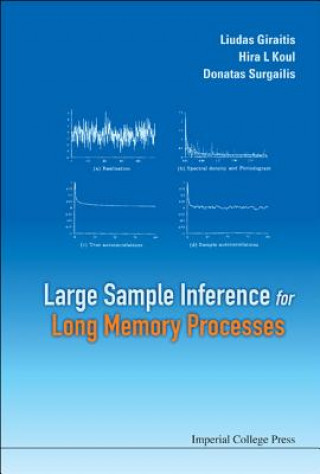
Large Sample Inference for Long Memory Processes
 Engels
 284 b
284 b
Retourneren binnen 30 dagen
Klanten kochten ook







A discrete-time stationary stochastic process with finite variance is said to have long memory if its autocorrelations tend to zero hyperbolically in the lag, i.e. like a power of the lag, as the lag tends to infinity. The absolute sum of autocorrelations of such processes diverges and their spectral density at the origin is unbounded. This is unlike the so-called weakly dependent processes, where autocorrelations tend to zero exponentially fast and the spectral density is bounded at the origin. In a long memory process, the dependence between the current observation and the one at a distant future is persistent; whereas in the weakly dependent processes, these observations are approximately independent. This fact alone is enough to warn a person about the validity of the classical inference procedures based on the square root of the sample size standardization when data are generated by a long-term memory process. The aim of this volume is to provide a text at the graduate level from which one can learn, in a concise fashion, some basic theory and techniques of proving limit theorems for numerous statistics based on long memory processes. It also provides a guide to researchers about some of the inference problems under long memory.


Informatie over het boek
Engels
Categorieën

Geef dit boek vandaag nog cadeau
Dat gaat heel eenvoudig
1 Voeg het boek toe aan je winkelwagentje en selecteer Als cadeau bezorgen 2 Je krijgt van ons per omgaand een voucher 3 Het boek wordt bezorgd op het adres van de ontvangerDit vind je misschien ook interessant







 /
/
 Gebonden (paperback)
 181.03
€
181.03
€




 /
Gebonden (paperback)
18.06
€
/
Gebonden (paperback)
18.06
€







Hoi! Ik ben Libroamiko, je boekadviseur.
Hoe kan ik je helpen?