
 Contact
 Hoe winkelen bij ons werkt
Bezorging
Winkelgids
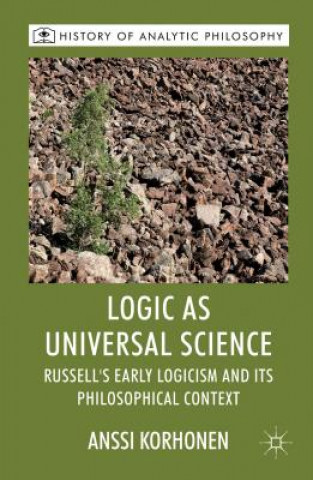
Logic as Universal Science
 Engels
 148 b
148 b
Retourneren binnen 30 dagen
Klanten kochten ook

















 /
/
 Gebonden (paperback)
 12.65
€
12.65
€



 /
Gebonden (paperback)
32.09
€
/
Gebonden (paperback)
32.09
€
 /
Gebonden (paperback)
26.93
€
/
Gebonden (paperback)
26.93
€



Bertrand Russell was a central figure in the rise of analytic philosophy, and there are few works in the genre whose influence is comparable to The Principles of Mathematics (1903), a book that established him as a major force in British philosophy. Logic as Universal Science takes a fresh look at the context of The Principles. This, it is argued, involves an extended argument against Kant's transcendental idealism and his conception of mathematics as a synthetic a priori science grounded in pure intuition. Philosophically, Russell's logicism substitutes pure logic for pure intuitions as the true source of mathematical knowledge. In this way, logic turns out to be a universal science and very far from Kant's general logic, which is a concise and dry science, delivering nothing but a purely formal criterion for knowledge. The picture of logic emerging from this opposition is investigated in detail for its content and consequences.


Informatie over het boek
Engels

Geef dit boek vandaag nog cadeau
Dat gaat heel eenvoudig
1 Voeg het boek toe aan je winkelwagentje en selecteer Als cadeau bezorgen 2 Je krijgt van ons per omgaand een voucher 3 Het boek wordt bezorgd op het adres van de ontvangerDit vind je misschien ook interessant
 /
Gebonden (paperback)
67.23
€
/
Gebonden (paperback)
67.23
€

 /
Gebonden (paperback)
42.82
€
/
Gebonden (paperback)
42.82
€



 /
Gebonden (harde band)
52.14
€
/
Gebonden (harde band)
52.14
€


 /
Gebonden (harde band)
39.28
€
/
Gebonden (harde band)
39.28
€




 /
Gebonden (harde band)
26.93
€
/
Gebonden (harde band)
26.93
€







Hoi! Ik ben Libroamiko, je boekadviseur.
Hoe kan ik je helpen?