
 Contact
 Hoe winkelen bij ons werkt
Bezorging
Winkelgids
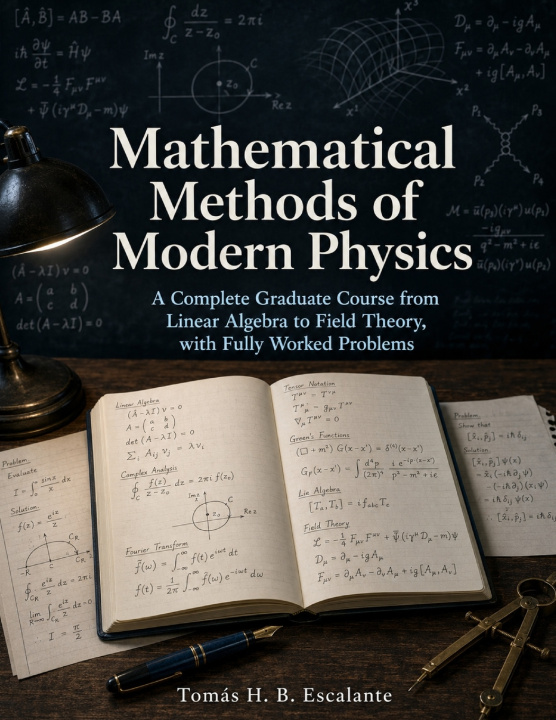
Mathematical Methods of Modern Physics
A Complete Graduate Course from Linear Algebra to Field Theory, with Fully Worked Problems
 Engels
 186 b
186 b
 Nieuw
Nieuw
Tot 30 dagen retourrecht

Every graduate physics course assumes that students already possess a broad mathematical toolkit, including Hilbert spaces, contour integration, Green's functions, tensors, and Lie algebras, yet no single course teaches this complete foundation in full. This book builds that toolkit from the ground up, one rigorous derivation at a time, and carries the reader from core undergraduate mathematics to the threshold of quantum field theory. Across 16 carefully connected chapters, it progresses from linear algebra and operators through complex analysis, Fourier and Laplace transforms, differential equations and dynamical systems, special functions, Sturm-Liouville theory, partial differential equations and Green's functions, the variational principle, differential geometry, group theory, and Lie groups, before closing with a working introduction to classical and quantum fields. No essential result is quoted and passed over without explanation because every important step is developed, justified, and shown in full.
What sets this book apart is the way it turns abstract mathematics into concrete, usable methods. Every chapter is anchored by fully worked examples involving real numbers, physical quantities, and consistent units, while short, runnable Python listings transform each method, including an LU solve, an FFT, a Metropolis sampler, and a curvature computation, into code that readers can execute, study, modify, and extend. Every chapter ends with carefully designed problems followed by complete, step-by-step solutions, ensuring that self-learning readers are never left without guidance when working through difficult ideas. The result is a single, coherent bridge from undergraduate mathematics to the language, techniques, and structures used throughout modern theoretical physics.
What's Inside
• Linear algebra, inner-product spaces, Hilbert spaces, operators, eigenvalue problems, and the spectral theory underlying quantum mechanics
• Complex analysis and contour integration, together with Fourier, Laplace, and integral-transform methods used throughout mathematical physics
• Ordinary differential equations and dynamical systems, special functions, and Sturm-Liouville eigenfunction expansions
• Partial differential equations of physics, Green's functions, kernels, and propagators, ranging from the heat kernel to retarded potentials
• The calculus of variations, analytical mechanics, tensor analysis, curved spaces, and differential geometry
• Group theory, Lie groups, and Lie algebras, including su(2), SU(3), the Lorentz group, and a first course in classical and quantum field theory
• Fully worked examples, runnable Python programs, and complete step-by-step solutions to every end-of-chapter problem
Why This Book
• Full derivations rather than quoted results, with every major method developed systematically from first principles
• Complete worked solutions to every end-of-chapter problem, addressing a major limitation found in many standard mathematical-physics texts such as Arfken and Riley
• Runnable Python programs that implement each method directly instead of presenting incomplete pseudocode
• Group theory, Lie algebras, differential geometry, and field theory included in the same volume as the classical mathematical toolkit
• A deliberate progression from linear algebra to field theory, allowing readers to understand how each mathematical topic connects to the next
• A self-study structure designed to support readers who do not have constant access to an instructor or formal graduate course


Informatie over het boek
Engels

Geef dit boek vandaag nog cadeau
Dat gaat heel eenvoudig
1 Voeg het boek toe aan je winkelwagentje en selecteer Als cadeau bezorgen 2 Je krijgt van ons per omgaand een voucher 3 Het boek wordt bezorgd op het adres van de ontvangerHoi! Ik ben Libroamiko, je boekadviseur.
Hoe kan ik je helpen?