
 Contact
 Hoe winkelen bij ons werkt
Bezorging
Winkelgids
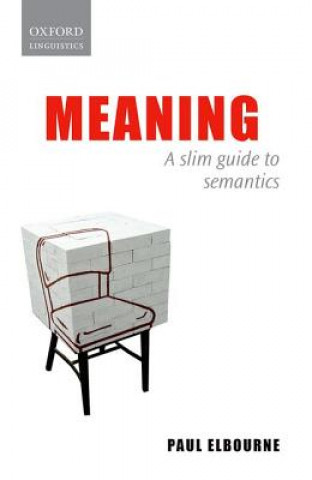
Meaning
 Engels
 85 b
85 b
Retourneren binnen 30 dagen
Klanten kochten ook





 /
/
 Gebonden (paperback)
 16.60
€
16.60
€













 /
Gebonden (paperback)
51.34
€
/
Gebonden (paperback)
51.34
€









This book offers an introduction to the analysis of meaning. Our outstanding ability to communicate is a distinguishing feature of our species. To communicate is to convey meaning, but what is meaning? How do words combine to give us the meanings of sentences? And what makes a statement ambiguous or nonsensical? These questions and many others are addressed in Paul Elbourne's fascinating guide. He opens by asking what kinds of things the meanings of words and sentences could be: are they, for example, abstract objects or psychological entities? He then looks at how we understand a sequence of words we have never heard before; he considers to what extent the meaning of a sentence can be derived from the words it contains and how to account for the meanings that can't be; and he examines the roles played by time, place, and the shared and unshared assumptions of speakers and hearers. He looks at how language interacts with thought and the intriguing question of whether what language we speak affects the way we see the world. Meaning, as might be expected, is far from simple. Paul Elbourne explores its complex issues in crystal clear language. He draws on approaches developed in linguistics, philosophy, and psychology - assuming a knowledge of none of them -in a manner that will appeal to everyone interested in this essential element of human psychology and culture.


Informatie over het boek
Engels

Geef dit boek vandaag nog cadeau
Dat gaat heel eenvoudig
1 Voeg het boek toe aan je winkelwagentje en selecteer Als cadeau bezorgen 2 Je krijgt van ons per omgaand een voucher 3 Het boek wordt bezorgd op het adres van de ontvangerDit vind je misschien ook interessant







 /
Gebonden (paperback)
10.22
€
/
Gebonden (paperback)
10.22
€





 /
Gebonden (paperback)
13.97
€
/
Gebonden (paperback)
13.97
€
 /
Gebonden (paperback)
16.40
€
/
Gebonden (paperback)
16.40
€
 /
Gebonden (harde band)
48.20
€
/
Gebonden (harde band)
48.20
€





 /
Gebonden (harde band)
172.98
€
/
Gebonden (harde band)
172.98
€
 /
Gebonden (paperback)
12.35
€
/
Gebonden (paperback)
12.35
€
Hoi! Ik ben Libroamiko, je boekadviseur.
Hoe kan ik je helpen?