
 Contact
 Hoe winkelen bij ons werkt
Bezorging
Winkelgids
Protein Kinase C Protocols
 Engels
 373 b
373 b
Tot 30 dagen retourrecht
Klanten kochten ook











 /
/
 Gebonden (paperback)
 17.08
€
17.08
€


 /
Gebonden (paperback)
20.42
€
/
Gebonden (paperback)
20.42
€

 /
Gebonden (paperback)
16.17
€
/
Gebonden (paperback)
16.17
€

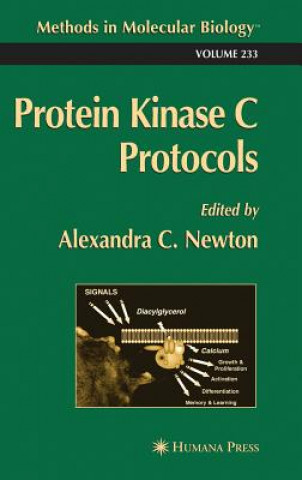
Since the discovery that protein kinase C (PKC) transduces the ab- dance of signals that result in phospholipid hydrolysis, this enzyme has been at the forefront of research in signal transduction. Protein Kinase C Protocols covers fundamental methods for studying the structure, function, regulation, subcellular localization, and macromolecular interactions of PKC. Protein Kinase C Protocols is divided into 11 sections representing the major aspects of PKC regulation and function. Part I contains an introduction and a historical perspective on the discovery of PKC by Drs. Yasutomi Nishizuka and Ushio Kikkawa. Part II describes methods to purify PKC. Part III describes the standard methods for measuring PKC activity: its enzymatic activity and its stimulus-dependent translocation from the cytosol to the membrane. Part IV describes methods for measuring the membrane interaction of PKC in vivo and in vitro. Part V provides methodologies and techniques for measuring the ph- phorylation state of PKC, including a protocol for measuring the activity of PKC’s upstream kinase, PDK-1. Novel methods for identifying substrates are described in Part VI. Part VII presents protocols for expressing and analyzing the membrane targeting domains of PKC. Part VIII provides a comprehensive c- pilation of methods used to identify binding partners for PKC. Part IX describes pharmacological probes used to study PKC. The book ends with a presentation of genetic approaches to study PKC (Part X) and a discussion of approaches used to study PKC in disease (Part XI).


Informatie over het boek
Engels
Categorieën

Geef dit boek vandaag nog cadeau
Dat gaat heel eenvoudig
1 Voeg het boek toe aan je winkelwagentje en selecteer Als cadeau bezorgen 2 Je krijgt van ons per omgaand een voucher 3 Het boek wordt bezorgd op het adres van de ontvangerDit vind je misschien ook interessant

 /
Gebonden (paperback)
11.21
€
/
Gebonden (paperback)
11.21
€


 /
Gebonden (harde band)
46.81
€
/
Gebonden (harde band)
46.81
€


 /
Gebonden (paperback)
44.48
€
/
Gebonden (paperback)
44.48
€


 /
Gebonden (paperback)
51.66
€
/
Gebonden (paperback)
51.66
€

 /
Gebonden (paperback)
13.94
€
/
Gebonden (paperback)
13.94
€






Hoi! Ik ben Libroamiko, je boekadviseur.
Hoe kan ik je helpen?