
 Contact
 Hoe winkelen bij ons werkt
Bezorging
Winkelgids
 Engels
 391 b
391 b
Retourneren binnen 30 dagen
Klanten kochten ook















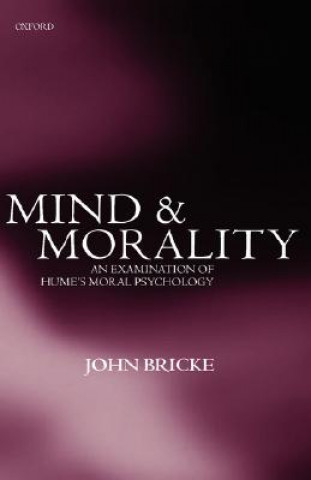
John Bricke presents a philosophical study of the theory of mind and morality that David Hume developed in his Treatise of Human Nature and other writings. The chief elements in the theory of mind are Hume's accounts of reasons for action and of the complex interrelations of desire, volition, and affection. On this basis, Professor Bricke lays out and defends Hume's thoroughgoing non-cognitivist theory of moral judgement, and shows that cognitivist and standard sentimentalist readings of Hume are unsatisfactory, as are the usual interpretations of his views on the connections between morality, justice, and convention. Hume rejects any conception of moral beliefs and moral truths. He understands morality in terms of distinctive desires and other sentiments that arise through the correction of sympathy. He represents moral desires as prior to the other moral sentiments. Morality, he holds, in part presupposes conventions for mutual interest; it is not, however, itself a matter of convention. Mind and Morality demonstrates that Hume's sophisticated moral conativism sets a challenge that recent cognitivist theories of moral judgement cannot readily meet, and his subtle treatment of the interplay of morality and convention suggests significant limitations to recent conventionalist and contractarian accounts of morality's content.


Informatie over het boek
Engels
Categorieën

Geef dit boek vandaag nog cadeau
Dat gaat heel eenvoudig
1 Voeg het boek toe aan je winkelwagentje en selecteer Als cadeau bezorgen 2 Je krijgt van ons per omgaand een voucher 3 Het boek wordt bezorgd op het adres van de ontvangerDit vind je misschien ook interessant









 /
/
 Gebonden (harde band)
 119.81
€
119.81
€



 /
Gebonden (paperback)
21.97
€
/
Gebonden (paperback)
21.97
€





Hoi! Ik ben Libroamiko, je boekadviseur.
Hoe kan ik je helpen?