
 Contact
 Hoe winkelen bij ons werkt
Bezorging
Winkelgids
Module 7
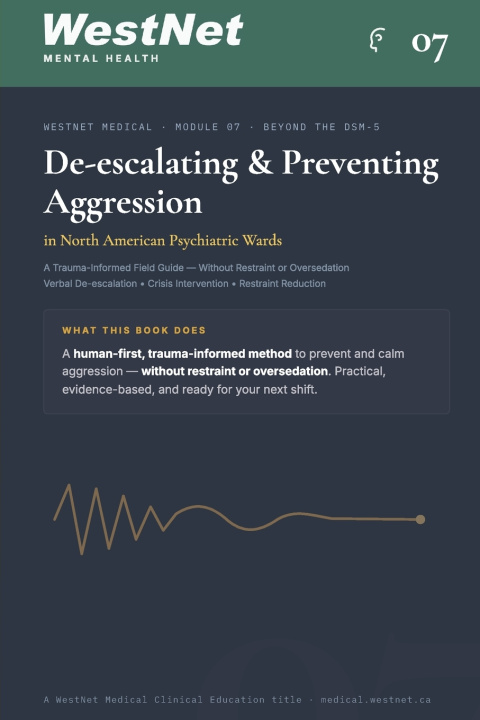
De-escalating & Preventing Aggression in North American Psychiatric Wards : A Trauma-Informed Field Guide to De-escalating Aggression in Psychiatric & Mental Health Wards - Without Restraint or Oversedation - Beyond the DSM-5
 Engels
 48 b
48 b
 Wordt verwacht
 Nieuw
Nieuw
Tot 30 dagen retourrecht

The de-escalation handbook for the moment the textbook skips. A patient is escalating, the ward is loud, and a diagnostic label tells you nothing about what to do in the next sixty seconds. This book does.
The De-Escalation Handbook for Mental Health is a practical, trauma-informed manual for preventing and calming aggression in psychiatric and mental-health settings. Written for nurses, mental-health technicians, physicians, security staff, and hospital educators, it replaces "label first, sedate second" with a human-first method you can use on your next shift. Most aggression is a survival response - fear, pain, powerlessness, or a nervous system that has learned nobody listens - and the standard ward reflex too often pours fuel on the fire. Here is the calm, repeatable alternative, and how to document what you did in language that holds up.
The old ward reflex, rewritten
- Instead of "calm down" - try "I'm here; take your time."
- Instead of raising the dose - ask whether the dose is the problem.
- Instead of crowding the patient - use one voice, one helper, and room to breathe.
- Instead of label-then-sedate - observe, then de-escalate.
- Instead of chasing a quiet ward - aim for a return to baseline.
What you'll be able to do
- Prevent aggression before it starts - read the early warning signs and remove the triggers the ward itself creates.
- De-escalate with your voice - one speaker, real choices, affect labeling, and the space that keeps everyone safe.
- Spot iatrogenic harm - tell drug-induced akathisia from "worsening psychosis" before you deepen the spiral.
- Rule out the fixable first - the HALT check that catches pain, hunger, delirium, and a full bladder.
- Climb the De-escalation Ladder - from a calm word to a genuine, documented last resort.
- Reduce restraint and seclusion - measure recovery, not silence, and restore patients to baseline.
- Protect your own nervous system - you cannot co-regulate a patient from a dysregulated state.
Inside the handbook
Thirty-four focused chapters, built like a course - not a lecture: the verbal de-escalation toolkit and "say this, not that" scripts; the trauma lens, ACEs, and the survival brain in plain language; Brøset violence-risk screening; akathisia vs. agitation; delirium, intoxication, and withdrawal that masquerade as crisis; suicide and self-harm safety planning; sensory rooms, restraint minimization, and the recovery model - with clinical diagrams, comparison tables, a scenario self-quiz with a full answer key, and a competency check.Part of a bigger mission
This is Module 07 of the WestNet Medical Clinical Education library - a growing global program, built on the WestNet Unified Health Platform, that treats the person and not the label. It is published by WestNet Medical Publications and co-published with WestNet Humanitarian Services, a United Nations-supplier NGO working to put dignified, evidence-based care within reach of every clinician, ward, and community - from major hospital systems to the smallest rural unit. Read this module free at medical.westnet.ca, explore the humanitarian mission at www.westnet.ngo, and license the full course library at learning.westnet.ca.Who it's for
Inpatient psychiatry, emergency departments, crisis and behavioral-health units, group homes, correctional health, schools of nursing, and long-term care - anywhere escalation happens and restraint should be the last option, not the first.See the person. Name what's driving the behavior. Lower the temperature without a syringe - then chart it defensibly.


Informatie over het boek
Engels

Geef dit boek vandaag nog cadeau
Dat gaat heel eenvoudig
1 Voeg het boek toe aan je winkelwagentje en selecteer Als cadeau bezorgen 2 Je krijgt van ons per omgaand een voucher 3 Het boek wordt bezorgd op het adres van de ontvangerHoi! Ik ben Libroamiko, je boekadviseur.
Hoe kan ik je helpen?