
 Contact
 Hoe winkelen bij ons werkt
Bezorging
Winkelgids
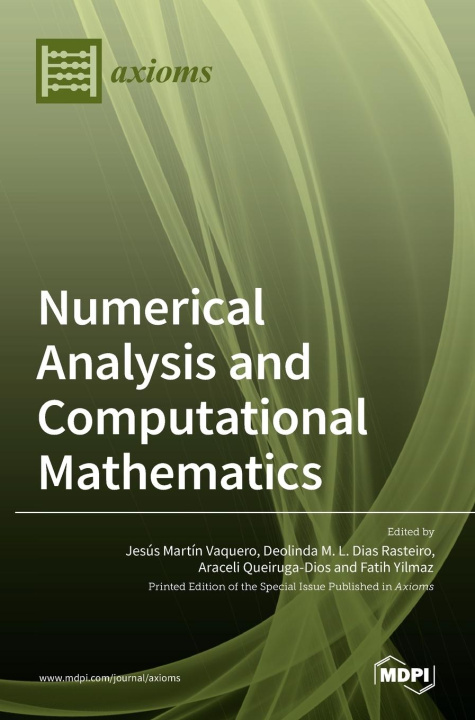
Numerical Analysis and Computational Mathematics
 Engels
 126 b
126 b
Retourneren binnen 30 dagen
Klanten kochten ook









Mathematical modeling is an active area of applied mathematics. At its beginning, engineers were the main practitioners of this area of mathematics, developing mathematical models to solve engineering problems in natural sciences.
However, analysis methods and models in social sciences are similar to those of nature sciences, including engineering, with the only difference being that instead of using principles of the nature, one uses principles or theories from experts of such social sciences.
Models based on ordinary or partial differential equations describe a wide variety of phenomena such as sound, heat, diffusion, electrostatics, electrodynamics, fluid dynamics, elasticity, or quantum mechanics, for example. Further, stochastic models have recently received increasing attention. Obviously, some of these types of complex problems also require a deep analysis of the tools utilized to solve these situations.
In this collection, we will attempt to integrate models, methods, and also applications, not only in the scope of traditional natural sciences, but also opening the scope to education and other social sciences. Theory and data-driven models, even in a synergy that gives rise to producing fertile, multidisciplinary, and hybrid models, can be considered.


Informatie over het boek
Engels
Categorieën

Geef dit boek vandaag nog cadeau
Dat gaat heel eenvoudig
1 Voeg het boek toe aan je winkelwagentje en selecteer Als cadeau bezorgen 2 Je krijgt van ons per omgaand een voucher 3 Het boek wordt bezorgd op het adres van de ontvangerDit vind je misschien ook interessant
 /
/
 Gebonden (paperback)
 41.00
€
41.00
€


 /
Gebonden (harde band)
23.38
€
/
Gebonden (harde band)
23.38
€





 /
Gebonden (harde band)
153.30
€
/
Gebonden (harde band)
153.30
€

Hoi! Ik ben Libroamiko, je boekadviseur.
Hoe kan ik je helpen?