
 Contact
 Hoe winkelen bij ons werkt
Bezorging
Winkelgids
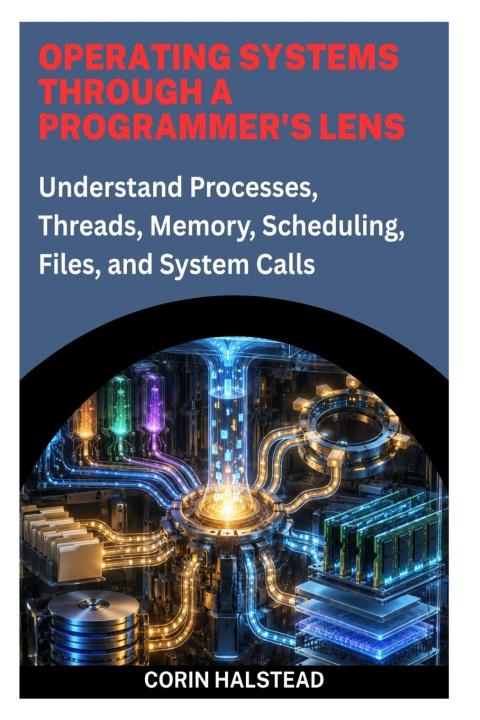
OPERATING SYSTEMS THROUGH A PROGRAMMER'S LENS
Understand Processes, Threads, Memory, Scheduling, Files, and System Calls
 Engels
 46 b
46 b
 Wordt verwacht
 Nieuw
Nieuw
Tot 30 dagen retourrecht

mmer's Lens gives developers a practical way to understand those decisions without requiring them to become kernel engineers.
Corin Halstead takes you beneath high-level programming abstractions to explain what really happens when an executable becomes a process, how threads share resources, why concurrency differs from parallelism, how schedulers divide CPU time, and how virtual memory turns addresses into protected mappings of physical resources.
You will explore page faults, copy-on-write, NUMA, stacks and heaps, system-call boundaries, file descriptors and handles, buffered versus durable writes, blocking and asynchronous I/O, backpressure, queue depth, resource limits, containers, sandboxing, and operating-system security.
The book also shows how modern runtimes interact with the OS through thread pools, coroutines, async/await, readiness and completion models, while practical performance chapters demonstrate how to investigate CPU pressure, lock contention, memory growth, I/O delays, scheduler behavior, and unexpected system calls using evidence rather than assumptions.
Linux receives substantial attention, but Windows and macOS are examined alongside it so you can recognize the same underlying concepts even when APIs and terminology differ.
Practical systems exercises help you observe process lifecycles, page faults, CPU saturation, lock contention, file-cache behavior, resource limits, and end-to-end latency in real environments. A cross-platform concept map then connects the major mechanisms across Linux, Windows, and macOS.
Stop treating the operating system as invisible infrastructure. Learn to see the mechanisms behind your code-and design software that works with the machine instead of accidentally fighting it.


Informatie over het boek
Engels

Geef dit boek vandaag nog cadeau
Dat gaat heel eenvoudig
1 Voeg het boek toe aan je winkelwagentje en selecteer Als cadeau bezorgen 2 Je krijgt van ons per omgaand een voucher 3 Het boek wordt bezorgd op het adres van de ontvangerHoi! Ik ben Libroamiko, je boekadviseur.
Hoe kan ik je helpen?