Gratis verzending vanaf 59,99 euro.

Word lid van een gemeenschap van boekenliefhebbers van over de hele wereld en krijg een heleboel voordelen.
Gratis account aanmaken
Gratis bezorging met Zásilkovna boven 59.99 €
DPD koerier 5.49 €
DHL koeriersdienst 5.49 €
GLS koerier 4.99 €
DPD-punt 3.99 €
 Contact
 Hoe winkelen bij ons werkt
Help
Bezorging
DPD koerier 5.49 €
DHL koeriersdienst 5.49 €
GLS koerier 4.99 €
DPD-punt 3.99 €
Gratis bezorging met Zásilkovna boven 59.99 €
Winkelgids
Mijn account
▸
Leeg :-(
0
Gratis verzending vanaf 59,99 euro.
OPTIMIZATION TECHNIQUES IN ENGINEERING
Foundations, Algorithms and Applications - From Classical Calculus to Metaheuristics and Machine-Learning-Assisted Design
Taal
 Engels
Engels
Boek
Gebonden (paperback)
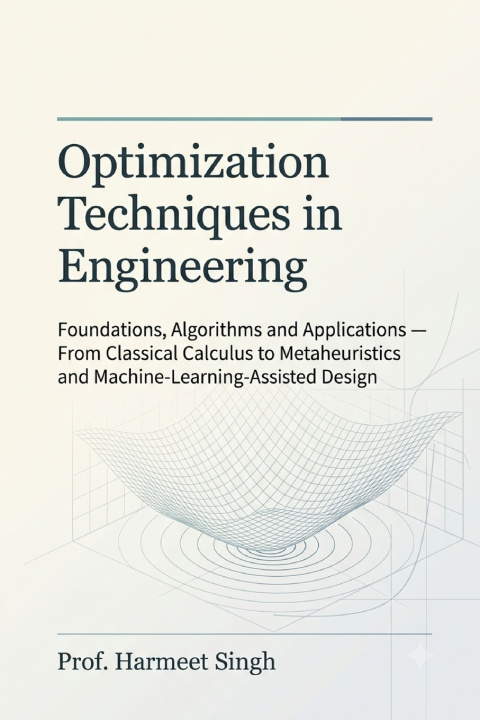
What the book tries to do. It tries to build, from first principles, an understanding of why optimiz...
Volledige beschrijving
Libristo-code: 53256935
?
 42 b
42 b
 Nieuw
Nieuw
42 b
Nieuw
17.52
€
In extern magazijn
Wordt binnen 14-21 dagen verzonden
Tot 30 dagen retourrecht

What the book tries to do. It tries to build, from first principles, an understanding of why optimization algorithms work - and, just as importantly, when they fail. Every algorithm in this book is presented in four layers:
- The idea. A plain-language statement of the trick that makes the method work, usually accompanied by a picture. If you remember nothing else from a chapter, remember the picture.
- The mathematics. The derivation, the conditions under which it is valid, and the convergence behaviour you should expect.
- The procedure. A step-by-step algorithm you could implement, in pseudocode or in Python, without further help.
- The engineering. A worked example drawn from a real discipline - a truss, a heat exchanger, a distribution network, a controller - carried through to numbers.
How the book is organised. The material is arranged in six parts.
- Part I - Foundations (Chapters 1-3) establishes vocabulary, the mathematical machinery of convexity and optimality, and - most neglected of all topics - the art of formulating an engineering problem so that it is solvable.
- Part II - Classical Deterministic Methods (Chapters 4-8) covers single-variable search, gradient-based multivariable methods, direct search, and the classical treatment of constraints through Lagrange multipliers, the Karush-Kuhn-Tucker conditions, penalty methods, and sequential quadratic programming.
- Part III - Linear, Network and Discrete Optimization (Chapters 9-13) develops linear programming and the simplex method, duality and sensitivity, network models, integer programming, and dynamic programming.
- Part IV - Metaheuristic and Nature-Inspired Methods (Chapters 14-17) treats genetic algorithms, swarm intelligence, simulated annealing, tabu search, differential evolution, and multi-objective optimization.
- Part V - Advanced Topics (Chapters 18-20) covers geometric and quadratic programming, optimization under uncertainty, and surrogate-based design.
- Part VI - Applications and Practice (Chapters 21-24) puts everything to work on structural, mechanical, electrical, chemical and civil case studies, surveys the software landscape, and closes with the fast-moving frontier where machine learning meets optimization.
Actrice
&
Polyglot
EWA KASP
voor
Video afspelen


Libristo heeft de grootste selectie boeken in vreemde talen. Daarom koop ik mijn boeken hier.
Informatie over het boek
Volledige naam
OPTIMIZATION TECHNIQUES IN ENGINEERING
Auteur
Harmeet Singh
Taal
Engels
Engels
Bindwijze
Boek - Gebonden (paperback)
Datum van uitgifte
2026
Aantal pagina's
346
EAN
9798187698622
Libristo-code
53256935
Uitgeverij
Independently published
Gewicht
465
Afmetingen
152 x 229 x 18
