
 Contact
 Hoe winkelen bij ons werkt
Bezorging
Winkelgids
Perfect Form
 Engels
 151 b
151 b
Retourneren binnen 30 dagen
Klanten kochten ook




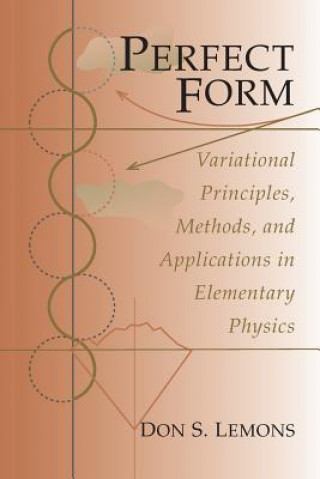
What does the path taken by a ray of light share with the trajectory of a thrown baseball and the curve of a wheat stalk bending in the breeze? Each is the subject of a different study yet all are optimal shapes; light rays minimize travel time while a thrown baseball minimizes action. All natural curves and shapes, and many artificial ones, manifest such 'perfect form' because physical principles can be expressed as a statement requiring some important physical quantity to be mathematically maximum, minimum, or stationary. "Perfect Form" introduces the basic 'variational' principles of classical physics (least time, least potential energy, least action, and Hamilton's principle), develops the mathematical language most suited to their application (the calculus of variations), and presents applications from the physics usually encountered in introductory course sequences. This text gradually unfolds the physics and mathematics. While other treatments postulate Hamilton's principle and deduce all results from it, "Perfect Form" begins with the most plausible and restricted variational principles and develops more powerful ones through generalization. One selection of text and problems even constitutes a non-calculus of variations introduction to variational methods, while the mathematics more generally employed extends only to solving simple ordinary differential equations. "Perfect Form" is designed to supplement existing classical mechanics texts and to present variational principles and methods to students who approach the subject for the first time.


Informatie over het boek
Engels
Categorieën

Geef dit boek vandaag nog cadeau
Dat gaat heel eenvoudig
1 Voeg het boek toe aan je winkelwagentje en selecteer Als cadeau bezorgen 2 Je krijgt van ons per omgaand een voucher 3 Het boek wordt bezorgd op het adres van de ontvangerDit vind je misschien ook interessant



 /
/
 Gebonden (harde band)
 32.57
€
32.57
€