
 Contact
 Hoe winkelen bij ons werkt
Bezorging
Winkelgids
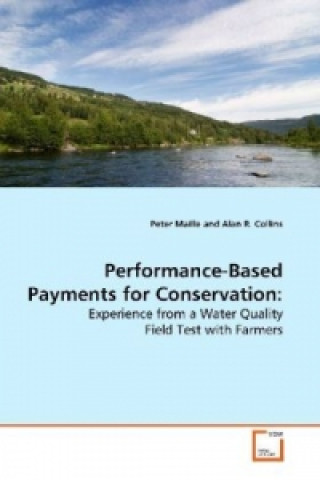
Performance-Based Payments for Conservation:
Experience from a Water Quality Field Test with Farmers
 Engels
 152 b
152 b
Tot 30 dagen retourrecht
Klanten kochten ook


 /
/
 Gebonden (paperback)
 10.18
€
10.18
€



 /
Gebonden (paperback)
26.11
€
/
Gebonden (paperback)
26.11
€
 Gebonden (paperback)
25.00
€
Gebonden (paperback)
25.00
€





 /
Gebonden (paperback)
52.94
€
/
Gebonden (paperback)
52.94
€



This monograph describes the planning and first 15§months of a water quality field experiment. In this§experiment a group of farmers in a small watershed in§the Appalachian Mountains received payments for the§water flowing from their watershed. These payments§were structured to increase with increasing water§quantity and quality. As a way to reduce non-point§source pollution, this represents a radical§realignment of responsibilities. Rather than adhering§to contract requirements in a government conservation§program, this approach calls on farmers to assess the§pollution problem across the watershed, identify and§implement conservation practices, and allocate water§quality payments among themselves. We describe the§watershed and economic models used to determine water§prices and structure the payments, outline the formal§and informal institutional arrangements that this§research hinges upon, and discuss farmers responses§based on observed behavior and two rounds of surveys.§Researchers and practitioners working with farmers on§water quality conservation, and those developing§programs using payments for environmental services,§should find this applied research very helpful. This monograph describes the planning and first 15§months of a water quality field experiment. In this§experiment a group of farmers in a small watershed in§the Appalachian Mountains received payments for the§water flowing from their watershed. These payments§were structured to increase with increasing water§quantity and quality. As a way to reduce non-point§source pollution, this represents a radical§realignment of responsibilities. Rather than adhering§to contract requirements in a government conservation§program, this approach calls on farmers to assess the§pollution problem across the watershed, identify and§implement conservation practices, and allocate water§quality payments among themselves. We describe the§watershed and economic models used to determine water§prices and structure the payments, outline the formal§and informal institutional arrangements that this§research hinges upon, and discuss farmers responses§based on observed behavior and two rounds of surveys.§Researchers and practitioners working with farmers on§water quality conservation, and those developing§programs using payments for environmental services,§should find this applied research very helpful.


Informatie over het boek
Engels

Geef dit boek vandaag nog cadeau
Dat gaat heel eenvoudig
1 Voeg het boek toe aan je winkelwagentje en selecteer Als cadeau bezorgen 2 Je krijgt van ons per omgaand een voucher 3 Het boek wordt bezorgd op het adres van de ontvangerDit vind je misschien ook interessant
 /
Gebonden (paperback)
83.81
€
/
Gebonden (paperback)
83.81
€




 /
Gebonden (paperback)
43.66
€
/
Gebonden (paperback)
43.66
€





 /
Gebonden (paperback)
10.28
€
/
Gebonden (paperback)
10.28
€
 /
Gebonden (paperback)
13.00
€
/
Gebonden (paperback)
13.00
€













Hoi! Ik ben Libroamiko, je boekadviseur.
Hoe kan ik je helpen?