Contact
 Hoe winkelen bij ons werkt
Bezorging
Winkelgids
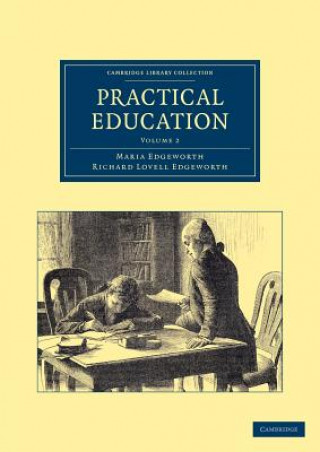
Practical Education
 Engels
 163 b
163 b
Retourneren binnen 30 dagen
Klanten kochten ook

 /
/
 Gebonden (paperback)
 32.60
€
32.60
€




The scientist Richard Lovell Edgeworth (1744–1817), educated at Trinity College, Dublin, and Oxford, was a Member of the Lunar Society of Birmingham, where he exchanged ideas with other scientists, including James Watt, and was known for his significant mechanical inventions. However, Edgeworth's real interest was education: in this 1788 two-volume work, written with his daughter, the poet Maria Edgeworth (1768–1849), he draws on his own experience of raising twenty children (by his four wives), from which the work derives its authority and innovative character. The work was very influential, and led to his Essays on Professional Education (1809; also reissued in this series). The two volumes discuss the theories of philosophers and educationalists, while in general arguing for the importance and formative character of early childhood experiences. Volume 2 discusses schooling, the idea of creativity and imagination, and the relationship between public and private education.


Informatie over het boek
Engels
Categorieën

Geef dit boek vandaag nog cadeau
Dat gaat heel eenvoudig
1 Voeg het boek toe aan je winkelwagentje en selecteer Als cadeau bezorgen 2 Je krijgt van ons per omgaand een voucher 3 Het boek wordt bezorgd op het adres van de ontvangerDit vind je misschien ook interessant
 /
Gebonden (paperback)
19.33
€
/
Gebonden (paperback)
19.33
€
 /
Gebonden (harde band)
33.62
€
/
Gebonden (harde band)
33.62
€
 /
Gebonden (harde band)
101.98
€
/
Gebonden (harde band)
101.98
€
 /
Gebonden (paperback)
19.33
€
/
Gebonden (paperback)
19.33
€