
 Contact
 Hoe winkelen bij ons werkt
Bezorging
Winkelgids
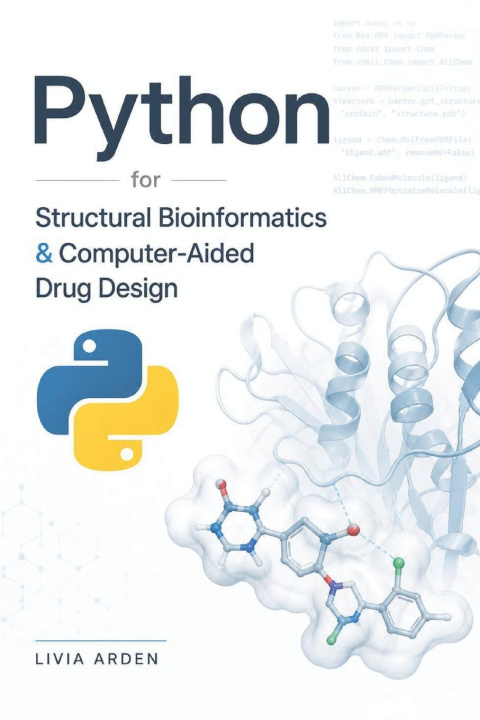
Python for Structural Bioinformatics & Computer-Aided Drug Design
 Engels
 90 b
90 b
 Nieuw
Nieuw
Tot 30 dagen retourrecht

Reactive Publishing
Discover How Python Powers the Next Generation of Computational Biology and Molecular Discovery
Modern drug discovery sits at the intersection of structural biology, high-performance computing, and automated data pipelines. As the volume of macromolecular structures grows exponentially, the ability to programmatically analyze, manipulate, and simulate complex biophysical systems has become an essential skill for computational chemists, bioinformaticians, and pharmaceutical researchers.
Python for Structural Bioinformatics & Computer-Aided Drug Design provides a structured, developer-focused entry into the computational techniques transforming modern rational drug design. Written for researchers, data scientists, and quantitative analysts looking to translate biological data into actionable therapeutic insights, this text bridges the gap between raw biophysical data and production-grade Python scripts.
What You Will Learn:Macromolecular Data Ingestion & Parsing: Programmatically access, clean, and process multi-gigabyte structural files from the Protein Data Bank (PDB) and mmCIF formats using modern Python libraries.
Structural Feature Extraction: Compute 3D spatial properties, surface area metrics, electrostatic potentials, and residue interaction networks to quantify biomolecular architecture.
Small Molecule Representation & Chemoinformatics: Work with SMILES, SDF files, and molecular graphs to evaluate chemical space, calculate ADMET properties, and build library screening pipelines.
Virtual Screening & Molecular Docking: Prepare target receptors and ligand libraries, configure automated docking runs, and post-process binding energy scores for high-throughput hit identification.
Binding Site Analysis & Interaction Mapping: Automate the detection of cryptic pockets, catalytic residues, and hydrogen-bonding networks critical for lead optimization.
Reproducible Pipeline Design: Build modular, scalable Python workflows that integrate directly with standard computational chemistry suites and high-performance computing clusters.
This book is engineered for scientists and engineers ready to apply quantitative computing to modern biological challenges. Whether you are a bioinformatician expanding your toolkit into computer-aided drug design (CADD), a chemist looking to automate structural analysis, or a software engineer transitioning into life sciences data architectures, this guide delivers the clear, code-first perspective required to build robust computational pipelines.
Master the tools shaping the future of molecular discovery, and harness Python to streamline the pathway from structural data to therapeutic lead.


Informatie over het boek
Engels

Geef dit boek vandaag nog cadeau
Dat gaat heel eenvoudig
1 Voeg het boek toe aan je winkelwagentje en selecteer Als cadeau bezorgen 2 Je krijgt van ons per omgaand een voucher 3 Het boek wordt bezorgd op het adres van de ontvangerHoi! Ik ben Libroamiko, je boekadviseur.
Hoe kan ik je helpen?