
 Contact
 Hoe winkelen bij ons werkt
Bezorging
Winkelgids
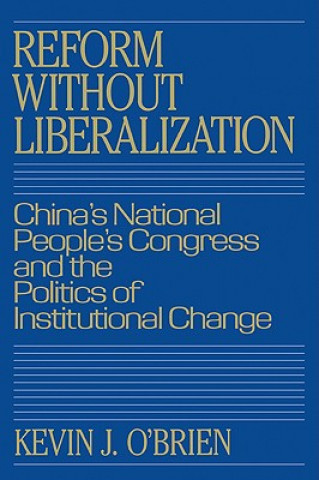
Reform without Liberalization
China's National People's Congress and the Politics of Institutional Change
 Engels
 109 b
109 b
Retourneren binnen 30 dagen
Klanten kochten ook

 /
/
 Gebonden (paperback)
 26.01
€
26.01
€




 /
Gebonden (paperback)
7.08
€
/
Gebonden (paperback)
7.08
€









Since its founding in 1954, the National People's Congress of China (NPC) has followed a difficult course of development, a course which has been characterized by periods of limited progress intermingled with periods of stagnation and regression. Political campaigns from the Anti-Rightist Movement (1957–1958) to the Great Leap Forward (1958–1960) to the Cultural Revolution (1966–1976) frustrated the establishment of any consistent policy concerning the appropriate role of the legislature within the one-party, Maoist regime. Mao's death in 1976, however, ushered in a new era of political reform which has included the strengthening of the NPC. In this detailed study of the NPC, Kevin O'Brien examines how the NPC has changed from its founding under Mao through the regime of Deng Xiaoping. He describes the various functions it has served, from the management of intra-elite relations; to the incorporation, and co-optation, of criticisms of regime policies into regime debates; to legislation and supervision of government agencies.


Informatie over het boek
Engels

Geef dit boek vandaag nog cadeau
Dat gaat heel eenvoudig
1 Voeg het boek toe aan je winkelwagentje en selecteer Als cadeau bezorgen 2 Je krijgt van ons per omgaand een voucher 3 Het boek wordt bezorgd op het adres van de ontvangerDit vind je misschien ook interessant


 /
Gebonden (paperback)
10.62
€
/
Gebonden (paperback)
10.62
€

 /
Gebonden (paperback)
14.88
€
/
Gebonden (paperback)
14.88
€





 /
Gebonden (paperback)
51.73
€
/
Gebonden (paperback)
51.73
€

 /
Gebonden (paperback)
35.43
€
/
Gebonden (paperback)
35.43
€
 /
Gebonden (paperback)
17.20
€
/
Gebonden (paperback)
17.20
€
 /
Gebonden (harde band)
123.63
€
/
Gebonden (harde band)
123.63
€




 /
Gebonden (paperback)
53.86
€
/
Gebonden (paperback)
53.86
€

Hoi! Ik ben Libroamiko, je boekadviseur.
Hoe kan ik je helpen?