
 Contact
 Hoe winkelen bij ons werkt

Bezorging
Winkelgids
Religion
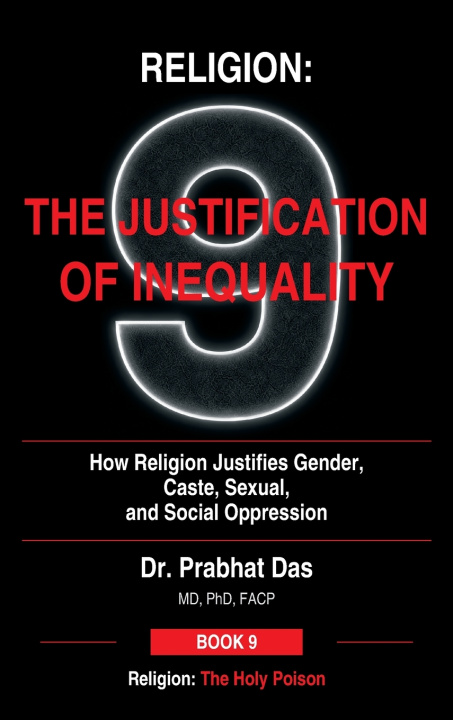
The Justification of Inequality: How Sacred Authority Defends Inequality in Gender, Caste, Wealth, Sexuality, and Belief
 Engels
 67 b
 Nieuw
Tot 30 dagen retourrecht

What if some of humanity's oldest injustices survived because people were taught that God approved of them?
Why were women denied authority because they were female? Why were people ranked by caste before they could speak? Why was same-sex love condemned as sin? Why were slavery, racial segregation, child marriage, and cultural domination repeatedly defended with scripture, purity, tradition, and divine order?
In Religion: The Justification of Inequality, physician, author, and lifelong atheist Dr. Prabhat Das confronts one of religion's most disturbing historical roles: its power to make human inequality look sacred.
Religion did not invent every injustice. Patriarchy, slavery, racism, caste, conquest, and prejudice also grew from politics, economics, fear, culture, and human self-interest.
But religion repeatedly added something far more dangerous.
Divine authority.
Male control became God's design.
Caste became sacred order.
Menstruation became impurity.
A widow's suffering became devotion.
Love became sin.
Racial separation became God's intention.
Colonial domination became civilization and salvation.
And once inequality is presented as the will of God, resistance becomes more difficult. A woman who challenges male authority can be accused of challenging religion. A Dalit who rejects caste can be accused of rejecting sacred order. A gay teenager can be taught to fear his own capacity to love. A slaveholder can read scripture and believe morality is on his side.
Dr. Das follows these ideas beyond theology and into real human lives. He examines women excluded from religious leadership, child marriage, widowhood, sati, purity rules, caste discrimination, untouchability, anti-LGBTQ doctrine and law, biblical defenses of slavery, opposition to interracial marriage, apartheid theology, Indigenous assimilation, and the continuing struggle between religious authority and equal human rights.
Then he asks the question religious institutions cannot easily answer:
If these unequal rules came from an unchanging God, why did so many of them change only after human beings fought against them?
This is not a neutral survey.
It is a direct, evidence-based challenge to the claim that sacred tradition deserves automatic moral respect.
Supported by history, law, religious texts, modern research, and human-rights evidence, Religion: The Justification of Inequality asks readers to stop being distracted by beautiful words such as "tradition," "purity," "protection," and "different but equal," and look instead at the structure underneath.
Who leads?
Who obeys?
Who decides?
Who is excluded?
Who loses freedom?
And who benefits?
Religion: The Justification of Inequality is Book 9 in Dr. Prabhat Das's 10-book series, Religion: The Holy Poison, a forceful examination of how organized religion can damage reason, freedom, equality, childhood, politics, peace, and human dignity.
No human being is born for a lower place.
And no inequality becomes moral simply because someone calls it sacred.


Informatie over het boek
Engels

Geef dit boek vandaag nog cadeau
Dat gaat heel eenvoudig
1 Voeg het boek toe aan je winkelwagentje en selecteer Als cadeau bezorgen 2 Je krijgt van ons per omgaand een voucher 3 Het boek wordt bezorgd op het adres van de ontvangerHoi! Ik ben Libroamiko, je boekadviseur.
Hoe kan ik je helpen?