Contact
 Hoe winkelen bij ons werkt
Bezorging
Winkelgids
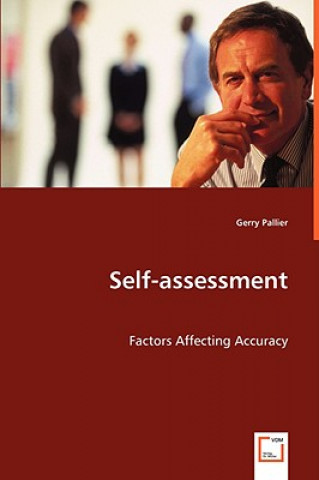
Self-assessment - Factors Affecting Accuracy
 Engels
 149 b
149 b
Retourneren binnen 30 dagen
Klanten kochten ook





 /
/
 Gebonden (paperback)
 34.90
€
34.90
€



Being able to judge the accuracy of one''s work is an important facet of human decision making. Psychological investigation into self-assessment has stemmed largely from the experimental cognitive tradition and mainly concentrates on probabilistic accounts related to rational thinking. A major aspect of this work relates to the confidence exhibited by individuals when assessing their decisions, and is thus often referred to as the ''confidence paradigm''. Another perspective has emerged in the last decade from the work of Differentialists. A robust outcome of these investigations is the existence of a ''confidence trait'' that appears to be, at least in part, a determinant of the accuracy of self-assessment. The current work takes this perspective further and examines alternative explanations for poor self-assessment. The outcomes suggest that are are a number of factors that determine accurate self-appraisal. These include question format, the difference between perceptual and cognitive tasks, gender and age. It seems that there is no single determinant of accurate self knowledge and many factors need to be accounted for when interpreting experimental findings.


Informatie over het boek
Engels
Categorieën

Geef dit boek vandaag nog cadeau
Dat gaat heel eenvoudig
1 Voeg het boek toe aan je winkelwagentje en selecteer Als cadeau bezorgen 2 Je krijgt van ons per omgaand een voucher 3 Het boek wordt bezorgd op het adres van de ontvangerDit vind je misschien ook interessant
 /
Gebonden (harde band)
606.76
€
/
Gebonden (harde band)
606.76
€