
 Contact
 Hoe winkelen bij ons werkt
Bezorging
Winkelgids
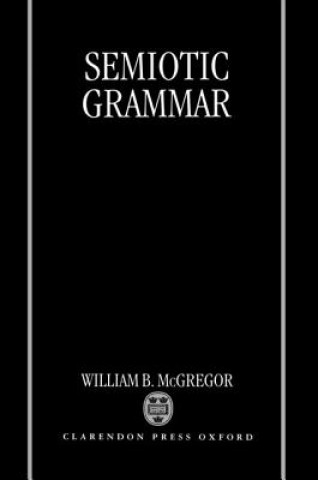
Semiotic Grammar
 Engels
 587 b
587 b
Tot 30 dagen retourrecht
Klanten kochten ook




 /
/
 Gebonden (paperback)
 17.44
€
17.44
€








 /
Gebonden (paperback)
28.23
€
/
Gebonden (paperback)
28.23
€





 /
Gebonden (paperback)
21.17
€
/
Gebonden (paperback)
21.17
€







The label 'semiotic grammar' captures a fundamental property of the grammars of human languages: not only is language a semiotic system in the familiar Saussurean sense, but its organizing system, its grammar, is also a semiotic system. This proposition, explicated in detail by William McGregor in this book, constitutes a new theory of grammar. Semiotic Grammar is 'functional' rather than 'formal' in its intellectual origins, approaches, and methods. It demonstrates, however, that neither a purely functional nor a purely formal account of language is adequate, given the centrality of the sign as the fundamental unit of grammatical analysis. The author distinguishes four types of grammatical signs: experiential, logical, interpersonal, and textural. The signifiers of these signs are syntagmatic relationships of the following types, respectively: constituency, dependency, conjugational (scopal) and linking (indexical, connective). McGregor illustrates and exemplifies the theory with data from a variety of languages including English, Acehnese, Polish, Finnish, Japanese, Chinese, and Mohawk; and from his pioneering research on Gooniyandi and Nyulnyul, two languages of the Kimberleys region of Western Australia.


Informatie over het boek
Engels

Geef dit boek vandaag nog cadeau
Dat gaat heel eenvoudig
1 Voeg het boek toe aan je winkelwagentje en selecteer Als cadeau bezorgen 2 Je krijgt van ons per omgaand een voucher 3 Het boek wordt bezorgd op het adres van de ontvangerDit vind je misschien ook interessant









 /
Gebonden (paperback)
36.30
€
/
Gebonden (paperback)
36.30
€





 /
Gebonden (harde band)
56.07
€
/
Gebonden (harde band)
56.07
€




 /
Gebonden (paperback)
27.43
€
/
Gebonden (paperback)
27.43
€




Hoi! Ik ben Libroamiko, je boekadviseur.
Hoe kan ik je helpen?